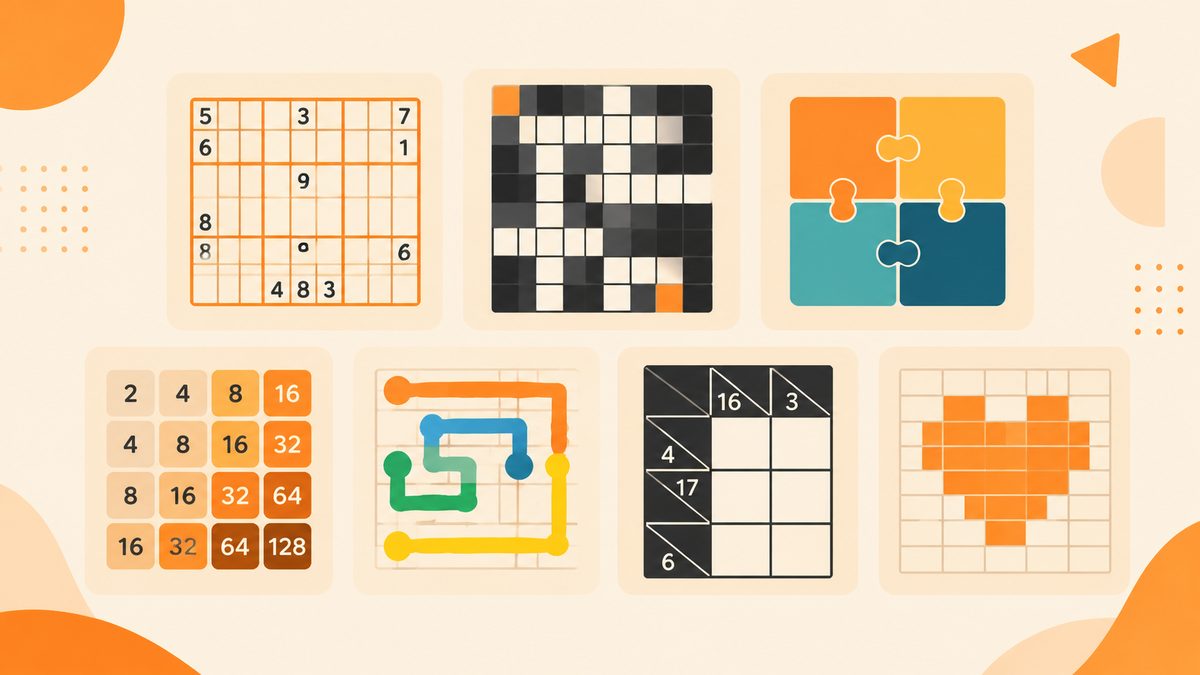
Seven games, one shared idea: a square grid, a set of rules you can learn in a minute, and exactly one correct answer. No account, no install, no paywall. This page is the map — what each game actually is, and which one you should open first.
Most people land here after finishing one daily board and wondering what else the site does. Fair question. The seven games look different at a glance — digits, suns, dominoes, a single line — but they're all logic puzzles of the same family. You don't guess your way through them. Every cell you fill is forced by the rules, which is why a board can feel hard for a minute and then collapse all at once.
They also share the same schedule. One daily puzzle per game, identical for everyone, and a fresh board at 00:00 UTC. Difficulty ramps through the week, easy on Monday and harder by the weekend. If you burn through the daily and want more, Unlimited generates a board on demand; if you missed a day, the Archive replays it. That's the whole product.
Progress lives in your own browser. Streaks, timers, hints, and share cards all work without an account, and once a board has loaded it keeps working if your connection drops. Nothing here is trying to sell you a subscription or nudge you toward a feed. You open a page, solve a grid, and leave.
The honest trade-off: because there's no account, your streak and stats don't follow you between phones or browsers. If you switch devices, they don't come with you. For a daily five-minute puzzle that's a fair price; for a competitive leaderboard habit, you'd notice. Most people don't.
The seven games, one block each
Below is a short read on every game — what it asks you to do, who it suits, and the link to play. The little board under each name is a thumbnail, not a real puzzle.
Sudoku — the 9×9 classic
Fill the grid so every row, every column, and every 3×3 box holds 1–9 once each. Given digits are fixed; tap a square and pick a number, or turn on Notes to pencil candidates. This is the game everyone already half-knows, and it's the natural home for anyone who likes elimination more than arithmetic.
Suits: experienced number-logic players. Expert and Evil difficulty live in Unlimited, not in the daily.
Mini Sudoku — a gentler 6×6
Every row and column holds 1–6 once, and the grid splits into six small 2×3 boxes. Same tap-to-fill and Notes as Sudoku, on a board that finishes in a couple of minutes. If the 9×9 feels like a wall, this is the door.
Suits: total beginners and a quick morning warm-up.
Patches — cut the grid into rectangles
Split the whole grid into rectangles with no overlaps and no gaps. Each rectangle holds exactly one clue cell; the clue's number is the rectangle's area, and a ? hides it so you work it out. A small badge tells you whether the shape must be a square, wide, tall, or anything. Drag corner to corner to draw a patch.
Suits: people who like spatial puzzles more than numbers.
Wend — trace the hidden words
The grid hides four to seven words, and the grey tiles are walls. Rows under the board show one blank per letter, so you know each word's length but not the word itself. Drag through adjacent letters — up, down, left, right, never diagonal — and the words can bend freely. The board is done when every open tile belongs to exactly one word.
Suits: word people who want something more logic-driven than a crossword.
Pips — place dominoes by the rules
You get a shaped board and a rack of dominoes; each half covers one cell. Cells form colored regions, and each region carries a rule: a number means the pips there add up to it, = means all pips match, ≠ means they all differ, <N or >N sets a sum ceiling or floor. A domino may straddle two regions. The board is solved when it's full and every rule is green.
Suits: players who want a little light arithmetic in their logic.
Zip — draw one line through every cell
Draw a single line from the number 1 to the last number, passing the numbers in order. The line has to visit every cell on the board and cannot cross a wall. Drag from the head of the line; drag back or tap an earlier cell to undo. It's a path puzzle, and the walls are where the trap lives.
Suits: anyone who enjoys tracing a route and watching out for dead ends.
Tango — suns and moons on a 6×6
Fill the board with suns and moons, putting exactly three of each in every row and column. You can never line three of the same side up in a row. Between two neighboring cells, an = means they match and a × means they differ. Tap once for a sun, twice for a moon, three times to clear.
= and × clue circles.Suits: beginners who want two symbols instead of nine, and anyone who liked the LinkedIn-style binary puzzles.
Daily vs Unlimited — what each one is for
The Daily is the same board for every person, once per game per day. It's built for the habit: one warm-up, one streak, a new board at 00:00 UTC. Difficulty follows the week — easy Monday and Tuesday, medium Wednesday through Friday, hard Saturday and Sunday. You don't choose the level; the week does.
Unlimited is the opposite. It generates a fresh board the moment you ask for one, at easy, medium, or hard. Sudoku adds expert and evil here, because those levels don't belong in a casual daily. Use Unlimited when you've already finished today's board and want another, or when you want to drill a specific difficulty instead of taking whatever the calendar handed you.
There's also an Archive: replay any past daily you missed. Streaks track the dailies; Unlimited doesn't break them, it just sits beside them.
My own habit is the dailies first, one or two in the morning, then Unlimited if a board caught something. I don't use Unlimited to chase difficulty as much as to drill a game I'm mediocre at. The weekly ramp is generous enough that you rarely feel crushed; the weekend hard boards are the ones worth saving more than a few minutes for.
Which one should you start with?
If you're picking your first grid on this whole site, don't open Sudoku by habit. Start with Tango or Mini Sudoku — both live on small boards and finish in a few minutes, so you learn the feel of a logic grid before the rules pile up. Want a chase instead of elimination? Open Zip. Want a little arithmetic? Open Pips. The table below is the short version.
| If you want… | Start here | Why |
|---|---|---|
| Your first ever grid | Tango or Mini Sudoku | Small board, two symbols or digits 1–6, done in minutes. |
| A path to trace around walls | Zip | One line, numbers in order, every cell covered. |
| A little arithmetic | Pips | Domino pips that have to satisfy sums and matches. |
| The classic number logic | Sudoku | Rows, columns, and 3×3 boxes; expert and evil in Unlimited. |
| Words hidden in a grid | Wend | Bent word paths around grey wall tiles. |
| Cutting shapes into a board | Patches | Rectangles whose areas are given by clues. |
A practical note: you don't have to pick one and stick to it. Most regulars keep two or three going — Tango on a groggy morning, Zip when they want to move around, Sudoku when they have ten minutes. The games share the same browser-based habit but scratch different itches, and switching between them is part of the fun rather than a reset.
Pick your first grid
Free, no account · a new daily puzzle at 00:00 UTC.
Frequently asked questions
Is everything really free?
Yes. The dailies, Unlimited, and the Archive are all free, with no account to create and nothing to install. Progress, streaks, and timers stay in your own browser. Once you've opened a board, it works offline.
Does each puzzle have exactly one solution?
It does. Every board is built so that the rules force a single answer, which means you never have to guess. If you're stuck, a cell is wrong or you've missed a deduction — not the puzzle.
Do I need to download an app?
No. This is a website; open it in any browser on your phone or computer. There's nothing to install and no update to wait for.
When does the daily reset?
At 00:00 UTC. That's the same instant for everyone, which is why the difficulty follows the calendar rather than your local clock.
Is this connected to LinkedIn or The New York Times?
No. Grid Puzzles is its own site, and you don't need a LinkedIn or New York Times account to play.
What's Unlimited actually for?
Practice and extras. Finished the daily and want another board? Training a harder difficulty? Unlimited generates on demand. It doesn't affect your daily streak.
Can I play a daily I missed?
Through the Archive, yes. Past dailies stay available to replay whenever you like.