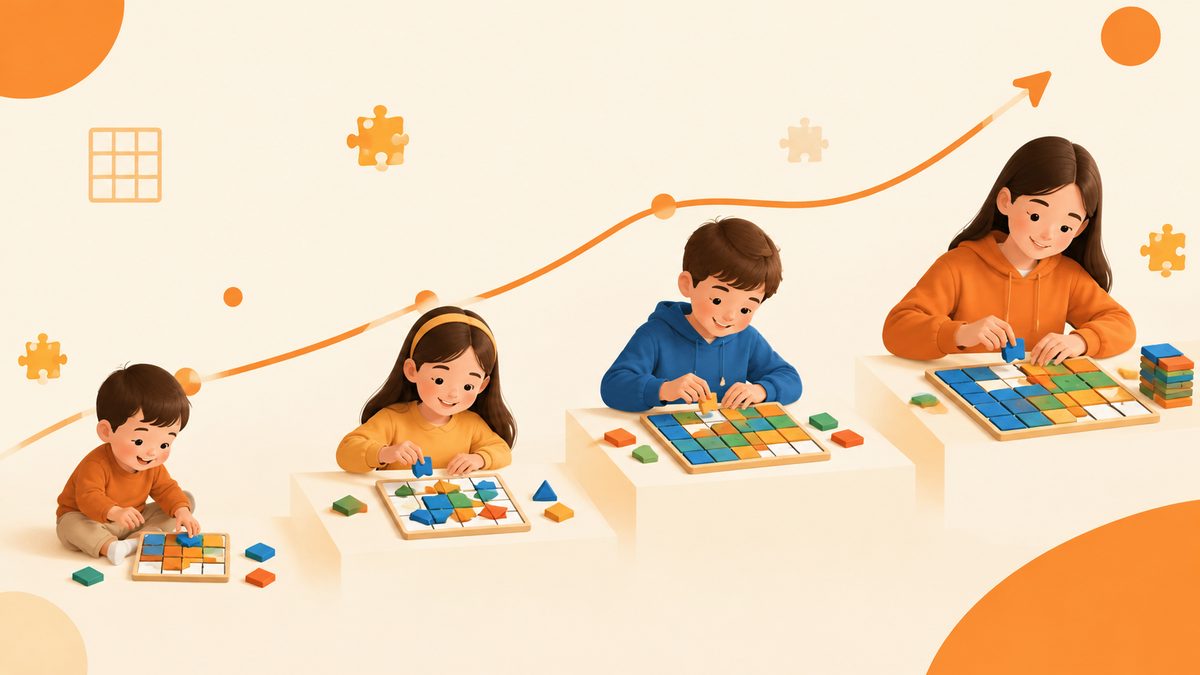
A five-year-old won't sit through a page of instructions. Put a small grid in front of them that fixes itself when they tap a square, and they'll stay with it for ten minutes. The trick is matching the game to the age, not forcing the classic 9×9 on everyone.
Most screen time fights a child for attention. A grid puzzle works the other way. The rules are short enough to say out loud in one breath, and every tap gives immediate feedback — the board either accepts the move or it doesn't. There's no load screen, no score to lose, and no video to wait through. That loop, small win after small win, is what keeps a kid leaning in.
It also helps that these games don't read like homework. You don't need a big vocabulary to place a sun next to a moon, or to trace a word through letters. A child who can count to six and follow "up, down, left, right" can play most of them. The hard part isn't the reading. It's holding two rules in your head at once, and that's exactly the muscle you want to stretch.
Ages 5–7: keep it tiny and visual
This age is about the habit, not the difficulty. Pick a board small enough that a child can see the whole thing at once and finish it in a few minutes. A 9×9 Sudoku looks like a wall of numbers here and will get closed immediately. Mini Sudoku, a 6×6 with digits 1 through 6, is the right size: every row and column holds 1–6 once, and the grid splits into six small 2×3 boxes. The given digits are fixed; a child taps an empty square and picks a number. Turn on Notes and they can pencil in candidates the way you would.
Simple Patches works at this age too, once they're comfortable with a pointer. Patches asks you to split the whole grid into rectangles with no overlaps and no gaps, and every rectangle holds exactly one clue. A clue's number is the area of that rectangle. On a small board this is more like fitting blocks than solving a puzzle — a child drags one corner to the opposite corner and watches the shape appear. A ? clue just means the area is hidden and they work it out.
Don't worry about winning or losing here. The point is that a child learns to look at a board, notice a forced move, and place it. If a puzzle is too hard for the day, leave it. The daily board resets at 00:00 UTC, but Unlimited generates a fresh easy board on demand, so there's always something at the right level.
Ages 8–10: add a second rule
This is the sweet spot. Kids this age can hold two constraints at once and start to feel the pull of a real deduction. Tango is my pick to introduce next. It's a 6×6 filled with suns and moons — three of each in every row and column — and you can never put three of the same in a row. Two signs sit between squares: = means the two match, × means they differ. Tap once for a sun, twice for a moon, three times to clear. There are no numbers to read, which is strangely freeing for a kid who's tired of math worksheets.
Patches moves up a notch at this age once the shape badges matter. The badge tells you whether a clue's rectangle has to be a square, wider than it is tall, taller than it is wide, or anything goes. That turns it from guessing shapes into ruling them out.
Wend is the word game of the set, and it lands well here. The grid hides four to seven words; grey tiles are walls. The rows under the board show one blank per letter, so a child knows each word's length but not the word. They drag through adjacent letters — up, down, left, right, never diagonal — and words can bend. Every open tile belongs to exactly one word, so the board is done when all tiles are used. A wrong trace flashes red and clears, which means mistakes are cheap.
Ages 11 and up: the real grind
Older kids are ready to layer constraints and chase a longer solve. Zip asks you to draw one unbroken line from the first number to the last, passing the numbers in order, visiting every cell and never crossing a wall. It sounds simple and it isn't — spotting a dead end before you seal a cell off is the whole game.
Pips adds arithmetic without becoming a math test. You place every domino so each half covers one cell, and colored regions carry rules: a number means the pips in that region add up to it; = means all pips match; ≠ means they're all different; <N or >N sets a sum boundary. A domino can straddle two regions. It's the closest thing to a logic workout in the set.
And yes, the full 9×9 Sudoku lands here. Difficulty follows the week — easy Monday and Tuesday, medium through Friday, hard on the weekend — and the expert and evil boards live in Unlimited, where an older kid can spend as long as they want. A Hint fills one square and names the technique it used, which turns a stuck moment into a lesson instead of a wall.
Pick the game by age
| Age | Start with | Why it fits |
|---|---|---|
| 5–7 | Mini Sudoku, simple Patches | Tiny boards, digits 1–6, drag-and-drop shapes; no reading-heavy rules. |
| 8–10 | Tango, Patches, Wend | Two-symbol deduction, shape badges, and word paths that bend. |
| 11+ | Zip, Pips, 9×9 Sudoku | Longer solves, walls, domino sums, and expert/evil difficulty. |
How to actually use it
Keep sessions short. Five to ten minutes is plenty. A daily board is designed to be finished, not lived in. Stop while it's still fun and the kid will ask for tomorrow's.
Let a hard puzzle wait. If today's board is over their head, switch to Unlimited and take an easy one, or come back after lunch. Frustration is a signal the difficulty is wrong, not that the kid is bad at it.
Solve side by side. Sit next to them on the couch and talk out loud: "That row already has three suns, so the rest have to be moons." You're not giving answers; you're showing the move. When they start doing the narrating themselves, it's working.
Let them repeat easy boards. It's tempting to push to the next difficulty as soon as they finish one, but a child consolidates a skill by doing it a few times at the level that feels easy. Unlimited lets them replay easy boards until the move is automatic, and the daily board will ramp up on its own.
Frequently asked questions
At what age can a child start?
Most five-year-olds can handle Mini Sudoku with a little help, because the board is small and the digits stop at six. The younger end needs a patient adult nearby, mainly to tap the right squares. There's no upper limit — the expert and evil Sudoku boards are genuinely challenging for grown-ups too.
Do these puzzles help with math?
They're not arithmetic drills, but they train the same habit kids need in math: looking at constraints and narrowing down what fits. Mini Sudoku and Pips touch numbers directly; Tango and Patches build the elimination part without numbers at all. Think of it as thinking practice that happens to use grids.
How much screen time is okay?
A daily board is a few minutes a day, which is a different thing from an infinite feed. There's no scroll, no algorithm, no ads chasing them between puzzles. One board, finish it, put it down. If a session runs long because they're on a roll in Unlimited, that's focus, not doomscrolling — though you can still call it when dinner's ready.
Do you need an account?
No. It's free and works in the browser; progress stays on the device. Every puzzle has exactly one solution, and the board works offline once you've opened the page.
Play Mini Sudoku
Free, no account · a new 6×6 puzzle every day.