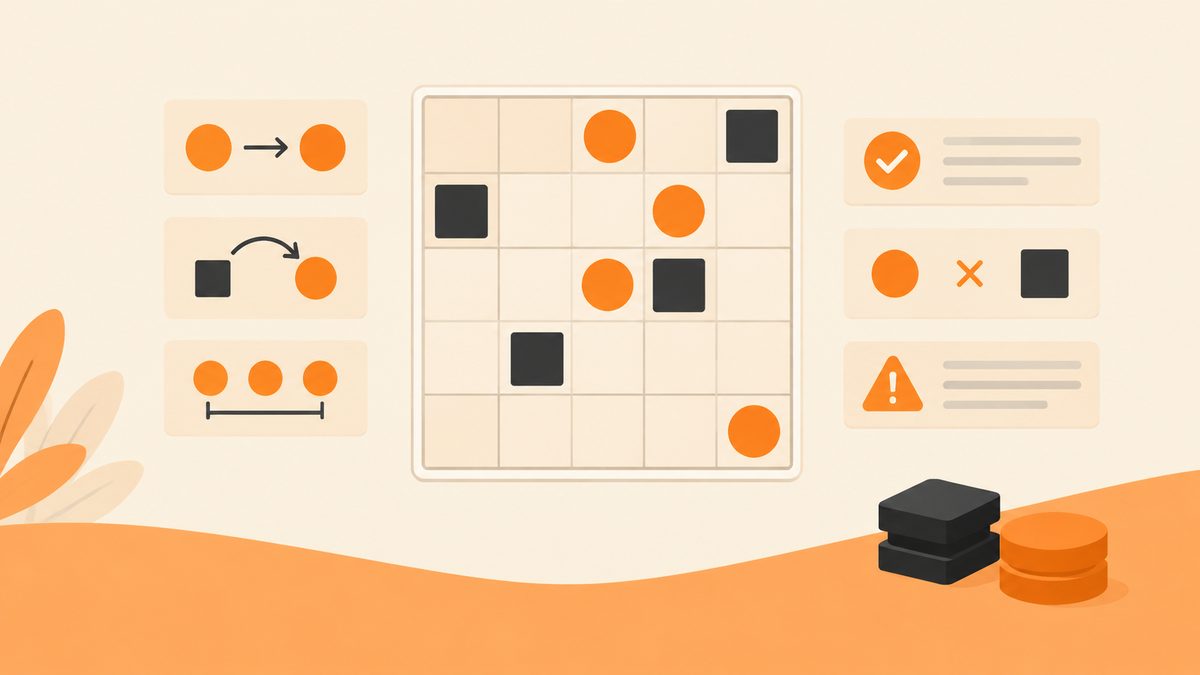
Tango is a 6×6 logic board where the only moves are sun and moon. The rules take a minute to learn, and once you read the little = and × signs as instructions instead of decoration, the board solves itself.
If you can fill a row with six cells, you can play Tango. There are no numbers to add, no letters to spell, and no timer breathing down your neck. You tap a square and it cycles through sun, moon, and back to blank. The whole game lives in the tiny signs printed between pairs of squares, and most beginners lose time by ignoring them.
This guide walks through a real board from the first sign to the finished grid. By the end you'll know the three rules, what each tap does, and why guessing is the one habit that will make you stuck.
What Is Tango?
Tango is a puzzle on a 6-by-6 grid. Every square ends up holding either a sun or a moon. The board starts with a few cells already filled and with small circular signs — an equals sign or a cross — sitting on the line between some neighboring squares. Your job is to fill the rest so every row and column balances and every sign tells the truth.
Each daily board has exactly one solution. There's no account to make, no install, and the next board unlocks at 00:00 UTC. If you burn through the daily one, Unlimited mode hands you a fresh board on demand at easy, medium, or hard.
The Three Rules
Everything on the board comes from three rules. If you can hold these three in your head, you never have to guess.
1. Three of each, every row and column
A row has six squares. It must contain exactly three suns and exactly three moons. The same is true for every column. That single fact does more work than anything else: the moment a row shows three suns, every remaining square in that row is a moon, and vice versa.
2. Never three of the same side by side
You can't place sun-sun-sun in a row, or moon-moon-moon, whether that run is horizontal or vertical. Two in a row is fine and common. Three is where the board starts forcing your hand, because it means the square immediately before and after a pair has to be the other symbol.
3. The = and × signs
A sign sits between two adjacent squares. An = means the two squares hold the same symbol — both suns or both moons. A × means they hold opposite symbols. These signs are fixed clues; they never change, and they're how you move from one known square to the next.
The Controls: One Tap Does All Three Jobs
Tango has no buttons for sun and moon. You tap the same square repeatedly and it cycles. That's the whole control scheme.
- Tap once on an empty square to place a sun.
- Tap again (twice total) to swap it to a moon.
- Tap a third time to clear the square back to blank.
So if you tap the wrong symbol, don't hunt for an undo — just keep tapping that cell. It's the fastest correction on the board. On a phone it's a fingertip; on a desktop it's a click.
Walkthrough: From the Signs to a Finished Row
Let's solve the board above. I'll name cells by row and column, so row 3 column 4 means the square in the third row down, fourth across.
Step 1 — Copy and flip off the signs
Start anywhere a sign touches a cell you can already fill. The = between row 1 columns 1 and 2 tells you those two match, but on its own it doesn't tell you whether they're suns or moons. The useful move is the × right next to it, between row 1 columns 2 and 3: whatever column 2 is, column 3 is the opposite.
Here's the trick. Look at row 1 columns 1 and 2 as a matching pair. If that pair were two moons, then column 3 — the opposite of column 2 — would be a sun. But column 4 is joined to column 3 by the × running down to row 2, which already points the other way. Rather than chase it in circles, take the pair the board hands you for free: the = between row 3 columns 3 and 4. Once the no-three rule forces one of those two cells, the other copies it.
Step 2 — Resolve a forced pair
Look at row 6. The = between columns 2 and 3 is a matching pair, but a match could be two suns or two moons — unless one side is already decided. Once column 1 in that row ends up a moon (column 1 is all alternating × clues, so it flips as you drop down it), the × to its right forces column 2 to be the opposite: a sun. Now the = has something to copy. Column 3 becomes a sun too. That's a forced pair, and you didn't guess it — the signs plus the row balance made it certain.
Step 3 — Fill rows that already hold three of one symbol
This is where the board starts to collapse. Row 1 now shows suns at columns 1, 2, and 4. That's three suns. Rule 1 says a row holds exactly three of each, so every empty cell left in row 1 — columns 3, 5, and 6 — has to be a moon. You can drop those moons in immediately and move on. The same check works for columns: the moment a column reaches three suns or three moons, the rest is forced.
Cascade that through the columns and the rest fills itself. Every time you drop a symbol, you check the row and column it landed in: has one of them reached three? If yes, the leftovers write themselves. If no, follow the next sign.
The Mistakes That Actually Trap Beginners
Ignoring the signs until the end
The signs are not decoration. They're the reason the board has a unique solution. If you fill in symbols first and only read the signs at the end, you'll find yourself undoing half the grid. Read them as you go — every sign is an instruction you can use right now.
Forgetting the no-three rule
It's easy to remember the three-of-each rule and completely miss "never three in a row." But the no-three rule is what forces cells. Two suns sitting next to each other mean the cells on either side must be moons. If you never look for those pairs, you'll miss the easiest forced moves on the board.
Guessing a matching pair
An = pair can be two suns or two moons, and on its own it's genuinely ambiguous. That's the temptation: pick one and see. Resist it. Instead, ask whether a neighbor already pins that pair down through a × sign or a column count. If nothing pins it yet, leave it and solve somewhere else. Guessing is the only way to create a contradiction that isn't actually there.
FAQ
How is Tango different from Sudoku?
Sudoku uses nine numbers and boxes. Tango uses only two symbols on a smaller 6×6 grid, and it adds the = and × signs between cells. If you already think in elimination, Tango feels familiar but moves faster.
What does the = sign mean exactly?
The two cells it sits between hold the same symbol. Both suns or both moons. It never means "close enough" — they have to match.
What's the × sign for?
It means the two cells are opposites: one sun, one moon. If you know one, you know the other.
Can I clear a cell I tapped wrong?
Yes. Keep tapping that same cell. It cycles sun, moon, blank — so a third tap clears it.
How many times do I get a new board?
One daily puzzle, same for everyone, refreshing at 00:00 UTC. If you finish it early, Unlimited mode generates a fresh board at easy, medium, or hard. The Archive lets you replay past dailies.
Is Tango free?
Yes. No account, no install. Progress and streaks stay in your browser, and the game works offline once you've opened it.
Play Tango
Free, no account · a new daily puzzle every day.