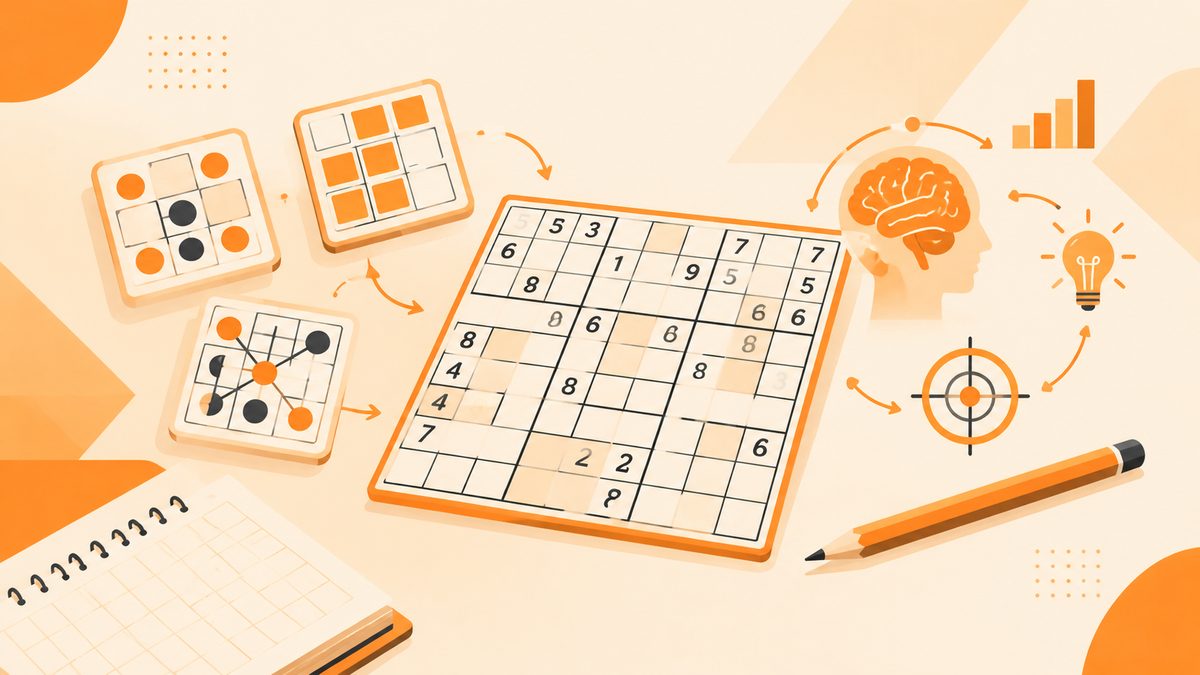
If you can finish a Hard Sudoku, you already own the hard part of these games. The rules change; the thinking doesn't. Here's what carries over, what's genuinely new, and which one to open first.
Sudoku trains a specific way of looking at a grid. You don't guess. You hold the constraints in your head — every row, column and box gets 1–9 once — and you cross off what a square can't be until only one option survives. You pencil candidates, spot a hidden single, and wait for a forced move. That's the whole skill.
Now look at the other games on the site. Tango, Patches and Wend all ask you to do the same thing with different objects: not digits, but suns, rectangles and letter paths. The surface changes; the move — narrow the options until one is forced — is identical. You're not learning a new way to think. You're learning new vocabulary.
What carries over from Sudoku
Three habits you've built in Sudoku transfer almost directly:
- Elimination. In Sudoku you cross off digits a row already contains. In Tango you cross off symbols a row already contains; in Patches you cross off rectangle shapes a clue can't be; in Wend you cross off letters a word can't bend through.
- Candidates. That Notes toggle you use in Sudoku? The same instinct applies — hold two possibilities in a square until a neighboring clue rules one out.
- One solution. Every board on the site has exactly one answer. You never guess; if two moves both seem open, you haven't read a constraint yet. That's the promise Sudoku players already trust.
What's new in each game
Tango — two symbols, and signs between squares
Sudoku gives you nine symbols and no relationship clues. Tango gives you only two — sun and moon — and adds something Sudoku never has: signs that sit between two squares. = means the two match; × means they differ. Every row and column holds three suns and three moons, and you can never place three of the same side by side.
The new skill is reading those signs first. A = pair forces two identical symbols next to each other; a × pair forces two different ones. Once you resolve a forced pair, the row count does the rest — exactly like finishing a Sudoku row that already holds seven digits. Tap once for a sun, twice for a moon, three times to clear.
Concretely: see a = between two empty cells and you know they're a pair, but you don't yet know whether that pair is suns or moons. Wait. Find a row that already has three suns, and the rest of that row has to be moons — now drop a moon into the half of the pair that sits in that row, and the = sign tells you the other half is a moon too. That chain, one clue lighting up the next, is the same chain you already follow in Sudoku.
Patches — areas and shapes, not digits
Patches drops numbers-as-entries and asks you to draw instead. Split the whole grid into rectangles — no overlaps, no gaps — and every rectangle holds exactly one clue. The clue's number is that rectangle's area in cells. A ? means the area is hidden. A small badge tells you whether the shape must be a square, wider than it is tall, taller than it is wide, or anything goes.
The new skill is spatial. Instead of asking "which digit fits here," you ask "how many cells does this block cover, and what shape can it be?" A clue of 1 is a single square; a clue of 6 with a "wide" badge can't be a 6×1 strip, so it has to be 3×2. Drag from one corner to the opposite corner to draw; tap a rectangle to remove it.
The Sudoku habit that helps most here is ignoring the noise. In Sudoku you work from the most constrained cell; in Patches you work from the most constrained clue. A corner clue or a small number has nowhere to go, so it's decided before anything else. Fill those first and the remaining space carves itself up, the way a near-complete box leaves you one obvious digit.
Wend — paths and words
Wend is the odd one out, and that's the point. The grid hides four to seven words; grey tiles are walls. Under the board, rows show one blank per letter, so you know each word's length but not the word. You drag through adjacent letters — up, down, left, right, never diagonal — and words can bend freely. Every open tile belongs to exactly one word, so the board is done when all tiles are used.
The new skill is pathing. It's less like Sudoku and more like a word maze: you trace a route that uses every open tile exactly once. A wrong trace flashes red and clears, so you can experiment cheaply. Hint reveals the next letter of the shortest unfound word.
Sudoku vs the new games, side by side
| Sudoku | Tango | Patches | Wend | |
|---|---|---|---|---|
| You place | Digits 1–9 | Suns and moons | Rectangle borders | A path through letters |
| The constraint | Row, column, 3×3 box | 3 of each per row/col, no three in a row, = / × signs | One clue per rectangle; number = area | Every open tile in one word; no diagonals |
| New skill | — | Reading the signs first | Spatial area and shape | Pathing and word length |
| Best first board | Daily easy | Daily easy | Unlimited easy | Daily easy |
A migration walkthrough
Start with Tango. It's the closest to Sudoku: a 6×6 grid, row and column logic, exactly one solution. Open the daily Tango and ignore the suns and moons for a minute. Look only at the = and × signs — those are your given digits. Resolve a forced pair, then count: a row with two suns already needs its remaining cells to be moons. You'll recognize the move immediately.
Then Patches. It feels different because you draw shapes instead of filling cells, but the deduction is the same: start from the most constrained clue. A single-cell clue, or a square clue with a tight badge, is your "hidden single." Expand from there, the way you'd fill a box that's almost complete.
Save Wend for last. It's the least Sudoku-like, and that's fine — it's a word maze, not a number grid. Play it when you want a change of mental scenery, not when you're trying to stay in the Sudoku groove.
You don't have to pick one. The site offers one daily board per game, so you can work today's Sudoku in the morning and open Tango over lunch. The useful thing about having several related games is that the "narrow it down" reflex stays warm across all of them; you're not learning three separate hobbies, you're learning three dialects of the same one.
If you only try one, make it Tango. It's the shortest distance from where you already are to a new game you'll finish in three minutes.
One thing to let go of: you don't have to be good at Sudoku to benefit. If your current level is "I finish the easy daily and leave the hard one," that's exactly enough. These games were built for that skill band, not for puzzle-book champions. The first Tango board will feel slightly odd because the symbols are new; the second will feel familiar; the third you'll finish before you've decided to.
Frequently asked questions
Do I need to be good at Sudoku to play these?
No. Sudoku experience just shortens the ramp. Tango and Patches are learnable from scratch in a few minutes; the rules are shorter than Sudoku's. The elimination habit helps, but it's not required.
Are these harder than Sudoku?
On the daily easy boards, no. They ramp the same way — easy Monday, harder by the weekend — and Unlimited lets you pick a difficulty. The expert and evil Sudoku boards are still the hardest thing on the site. Tango's weekend board is genuinely tricky, but it's tricky in a familiar way: you're still counting symbols and eliminating, just with two symbols instead of nine.
Can I use Sudoku techniques like candidates?
In Tango, yes — the row/column counting and forced-pair logic is the same. In Patches and Wend, the mental move is different (area and shape, or pathing), but the "narrow it down until one is forced" instinct still applies.
Is there one solution per board?
Yes. Every puzzle on the site has exactly one solution, and you're never expected to guess. If two moves both look open, you've missed a constraint.
Do I need an account?
No. Free in the browser, progress stays on your device, and a new board arrives at 00:00 UTC.
Play Sudoku
Free, no account · easy on Monday, expert and evil in Unlimited.