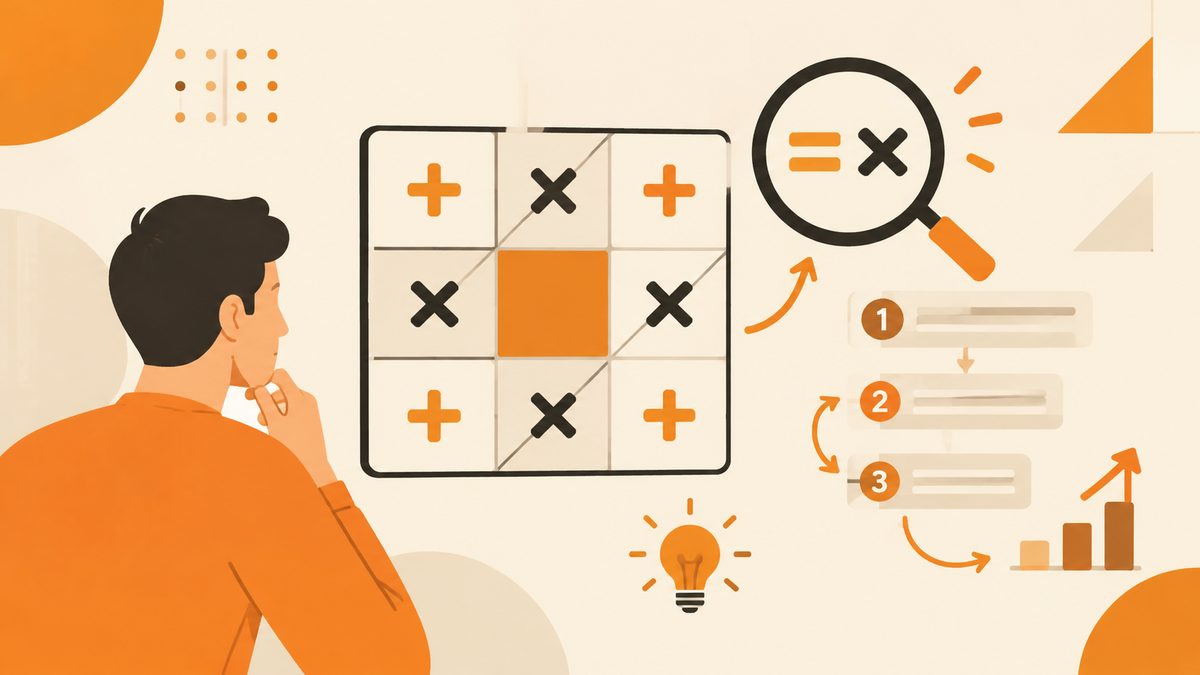
Most stuck Tango boards aren't hard — they're started wrong. People fill what looks obvious and drift toward a guess. The five techniques below are the order that actually works: start at the signs, let the board force the rest.
I used to open a Tango board and tap whichever cell looked interesting. That lasts about three cells before I'm staring at six blanks with no idea. What changed was simple: I stopped looking at the empty cells and started reading the little = and × marks first. Those signs are where every deduction on the board begins.
The rules in thirty seconds
Tango is a 6×6 board filled with suns and moons. Every row and column holds exactly three of each. You may never line three of the same side up in a row, horizontally or vertically. Between two neighboring cells, an = means the two cells match, and an × means they differ. Tap once for a sun, twice for a moon, three times to clear. That's everything — the techniques are just consequences of those three rules.
The reason people get stuck is that they treat the three rules as separate jobs. They aren't. The count rule and the no-three rule are constantly feeding each other: a row filling with moons tells you where the suns must go, and a pair of suns tells you where the moons must flank. The signs are just the start of that conversation. Read them as links between cells rather than as decorations, and the board stops being six blanks and starts being a chain.
1. Start from the signs
The marks are givens with direction. An = copies whatever value you find on one side onto the other. An × flips it. So if a cell next to an = is a moon, the other side is also a moon; follow that with an × and the next cell becomes a sun. You're not solving cells, you're tracing a chain.
On the board below, a given moon sits at the top-left. The = to its right copies it: the next cell is forced to moon. The × after that flips it again, forcing a sun. Two cells decided before I tapped anything else.
Do this for every sign on the board before you touch an unmarked cell. Half of most easy and medium boards collapses in the first minute.
The chain doesn't stay in one row. A vertical = between two cells in the same column copies a value up and down, and an × flips it. So after you finish a row, follow the signs in each column the same way. The goal of the opening is to convert every sign into a known cell, not to solve a single row end to end.
2. Forced pairs
An = edge is a pair that always arrives together. Once you know one cell of the pair, the other is locked. The useful part is what the pair blocks: two suns sitting next to each other make the cells on either side unsafe for a third sun, because three in a row is banned. So a forced sun-sun pair immediately turns its flanking cells into moons.
In the figure below, the = between the middle two cells copies a sun across. The little amber X marks show the two outer cells that now cannot be sun — they must be moons.
3. The no-three deduction
This is the rule that earns its keep. Two of the same side sitting next to each other — whether horizontal or vertical — force the two cells immediately on either end to be the other side. You can't have three in a row, so the pair sets its neighbors.
Look at the row below: two adjacent suns in the middle. The cells directly to their left and right can't be sun, so they become moons. It sounds small, but on a 6×6 board, every forced moon and sun shrinks the remaining options fast.
Vertical pairs behave identically. Two moons stacked in a column make the cells above and below them suns.
4. Row and column counts — three of each
Every row and column needs exactly three suns and three moons. That means once a row already holds three of one side, every blank cell in it is forced to the other side. It's easy to underuse this because it feels too simple — but it's the fastest way to finish a half-filled board.
The row below has three moons already. The one empty cell can't be a fourth moon, so it has to be a sun. Same logic in reverse for columns.
5. Boundary matching
The outer edges of the board are where the last cells usually fight you. A column near completion leaves one or two edge cells unresolved, and an = sitting on the top or bottom row will lock them together. Count the column first — once it's short exactly one sun, the = on the edge tells you the matching neighbor.
Below, the fourth column already holds three moons, so the top cell must be a sun. The = on the edge copies that result into the cell beside it. Two edge cells, one column count, one sign.
How the five techniques chain together
Nobody uses them one at a time. The solved board below is what the chain looks like end to end: signs traced first, pairs locked, no-three flanks filled, counts finished off, edge cells matched last.
When you're actually stuck
On a hard board you'll hit a point where no sign, pair, or count forces anything new. Resist the urge to tap a guess. Instead, look for the longest unresolved row or column — the one with three or four blanks — and ask what the counts allow. If a row has two suns and two moons and two blanks, the blanks are one of each, which means an = between those two blanks would be impossible and an × between them is what you should expect. Cross-check it against the column, and one of the two blanks usually resolves.
If that still won't move it, the likely culprit is an earlier cell you filled by instinct rather than by a forced chain. Clear the last few taps and re-read the signs in that area. With a single guaranteed solution, a contradiction means a wrong cell, not an ambiguous board.
The speed-solving order
Once the techniques are familiar, the order matters more than the technique itself. This is the sequence fast boards follow.
- Opening — read every sign. Traverse all the
=and×marks first, chaining out from whichever givens they touch. Don't fill a cell you haven't been forced to. - Middle — apply no-three and pairs. Look for any two adjacent matching cells and fill their flanks. Lock every
=pair you can. Re-scan the signs after each batch; new cells unlock new chains. - End — finish by counting. Rows and columns that already hold three of one side spill their remaining cells. Handle the outer edge cells last, where an
=on the border ties them off.
Play Tango
Free, no account · a new 6×6 board every day at 00:00 UTC.
Frequently asked questions
Do I really have to start with the signs?
On every board I'd say yes. The signs are the only givens that carry direction; the empty cells are just results. If you start filling empties first, you're guessing and the signs end up contradicting you.
What does the no-three rule actually forbid?
Three identical cells in a straight run — three suns or three moons — in any row or column. Two in a row are fine, and they're actually useful because they force the flanking cells.
How many suns and moons go in each row?
Exactly three of each, in every row and every column of the 6×6 board. That balance is what makes the counting technique work.
Why is my board stuck even after I used every sign?
You probably skipped a no-three flank or miscounted a row. Backtrack to the last cell you filled and check whether it created an adjacent pair you didn't exploit. You shouldn't need to guess on a valid board.
Is there more than one solution?
No. Every Tango board is built so the rules force a single answer. If two completions look possible, one of your cells is wrong.
How long should a board take?
Easy dailies fall in a couple of minutes once the signs come first. Weekend boards run longer as the clues get sparser. Unlimited mode lets you drill any difficulty.