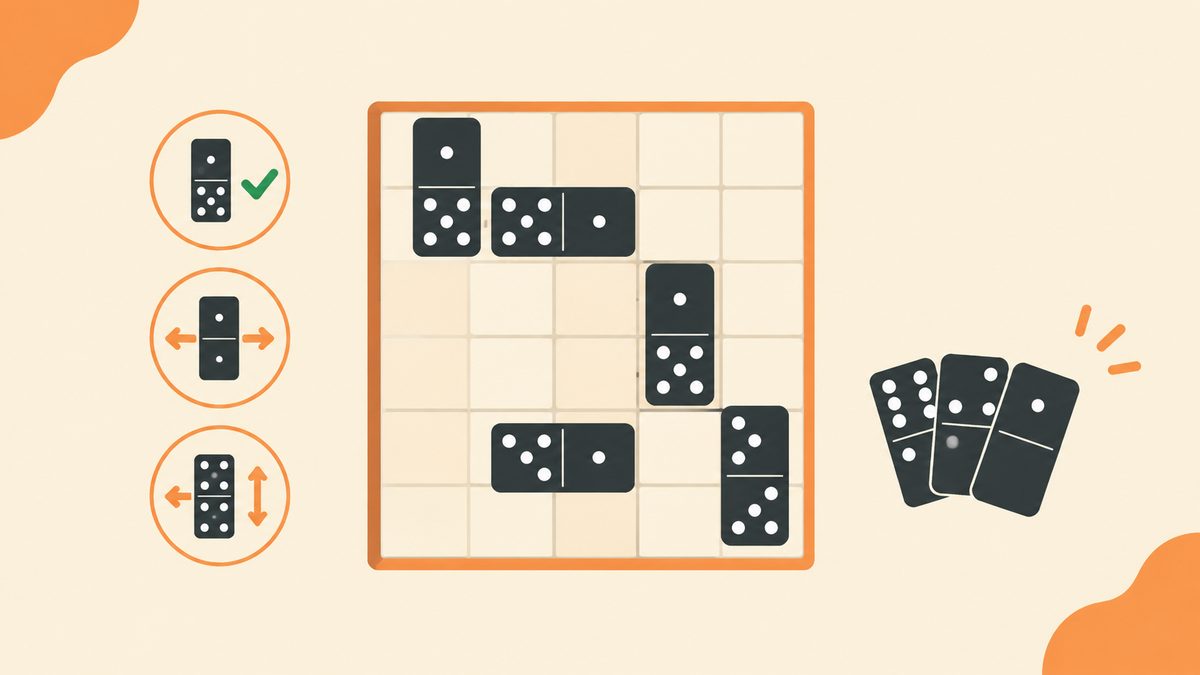
Your domino covers two adjacent cells. A colored region checks only the pip values inside its border, so a tile doesn't need to stay within one color.
Fill the board with the pieces in the rack. Every region must satisfy its label: a number gives an exact sum, = asks for matching values, and ≠ asks for different values. A label such as <5 limits the region's total to less than five. An unlabeled area has no extra pip condition.
Read a small board
This four-by-four example uses eight dominoes: three 1–1 pieces, four 1–2 pieces and one 3–4 piece. It's a worked example, not a daily puzzle to solve uniquely. The pink, blue and green regions each cover four cells. The orange <5 region covers just one. The three white cells beside and below it are unrestricted.
Place the top four pieces
Use two 1–1 dominoes across the pink region. Its four values are all 1, so its = rule is satisfied. The blue region can take two 1–2 pieces across its two rows. Their four halves total 2 + 1 + 2 + 1 = 6.
The middle line on each tile separates its two halves. When you check a rule, follow the colored border: it can cut across a tile.
Cross a region boundary
Put a 1–2 domino vertically in column 3, with its 2 in row 3 and its 1 directly below. The 2 lies in the orange cell. That's below five and satisfies <5. The other half contributes nothing to that rule because it is outside the orange border.
Across the bottom-left region, place a 1–2 piece in row 3 and the 3–4 piece in row 4. You now have 1, 2, 3 and 4 in those four cells, with no repeated value. Your last 1–1 piece fits vertically in column 4. It fills the two remaining white cells.
Use the rack as part of the clue
A region sum doesn't specify which dominoes belong there. Check both halves of a candidate piece and where its second half would land. Using a useful value in an unrestricted area can leave another region without the piece it needs.
The sequence above shows one valid arrangement of the listed pieces. On a different board, a constrained region may need a domino to cross its border, or the neighboring spaces may force a different orientation. Satisfying one label is not enough if the remaining pieces can't cover the empty cells.
Rotate and move dominoes
Tap a domino in the rack to rotate it, then drag it onto the board. You can also tap a placed piece to rotate it or drag it off the board to return it to the rack. Check the landing outline before releasing a tile, especially beside an irregular edge.
If a label isn't satisfied, inspect the values inside that region. For a sum, count every half inside the border. For = or ≠, compare the individual cell values, not the totals on the dominoes. You're done when every cell is covered and every region rule is satisfied.
Play Pips
Try a daily board or choose an unlimited puzzle.