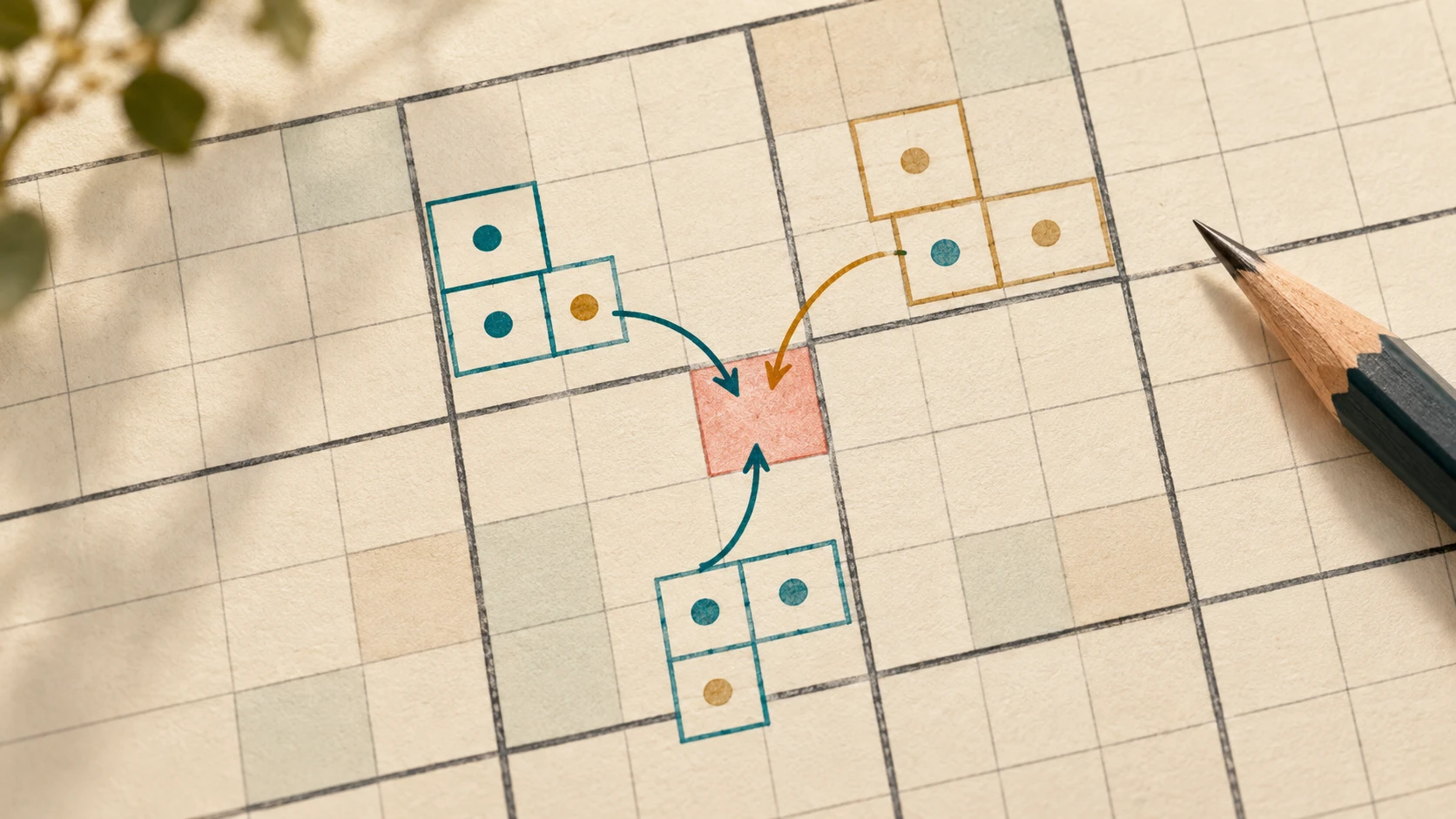
In the grid below, r9c7 has candidates 2 and 3. An XYZ-Wing removes the 3, leaving a certain 2. The useful detail is that another nearby cell sees both wings but cannot lose its 3. Checking the pivot makes the difference.
An XYZ-Wing uses a cell with three candidates, called the pivot, and two cells with two candidates each, called the wings. Each wing must see the pivot. Here, “see” means share a row, column or 3×3 box; being close on the screen is not enough.
Find these three cells first
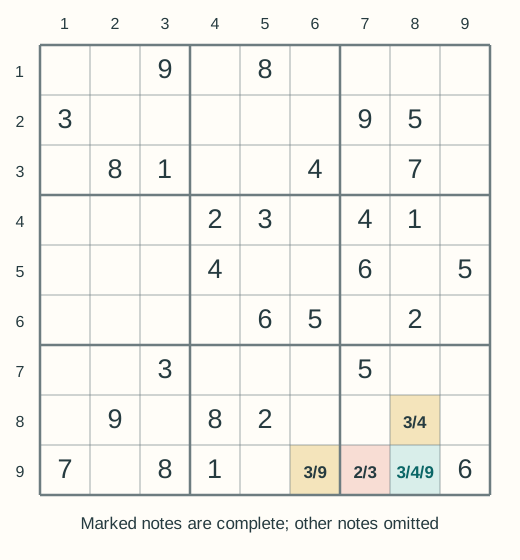
The coordinates count rows from the top and columns from the left. All the marked candidates follow directly from the displayed clues; no earlier pencil-mark removals are needed.
| Role | Cell | Complete candidates | Connection to the pivot |
|---|---|---|---|
| Pivot | r9c8 | 3, 4, 9 | — |
| First wing | r8c8 | 3, 4 | Column 8 and bottom-right box |
| Second wing | r9c6 | 3, 9 | Row 9 |
| Target | r9c7 | 2, 3 | Row 9 and bottom-right box |
The wings share 3. One combines it with the pivot's 4; the other combines it with the pivot's 9. Those two-candidate lists matter. If a wing also allowed a fourth digit, excluding 4 or 9 would no longer force it to be 3.
Do not fill the pivot yet. The pattern tells us something useful without deciding which of its three candidates is correct.
Follow the pivot's three possibilities
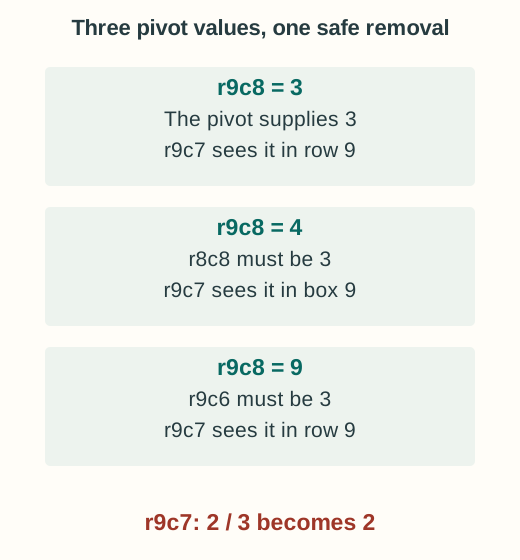
If r9c8 is 3, the target r9c7 cannot be 3 because both cells are in row 9.
If r9c8 is 4, r8c8 cannot also be 4. Its only other candidate is 3. The target sees that wing in the bottom-right box, so it cannot be 3.
If r9c8 is 9, r9c6 cannot also be 9. That wing must be 3 instead, and the target sees it along row 9.
That covers every candidate in the pivot. In every case, one of these three cells contains 3, and the target sees whichever one it is. Remove 3 from r9c7. Its remaining candidate is 2.
The elimination is the technique's result. A placement follows here because the target began with only two candidates. On another board, removing one candidate may leave several, and that is still a useful deduction.
The tempting removal that would be wrong
Now inspect r8c6, with candidates 3, 6, 7. It looks promising: it sees the first wing along row 8 and the second wing in column 6.
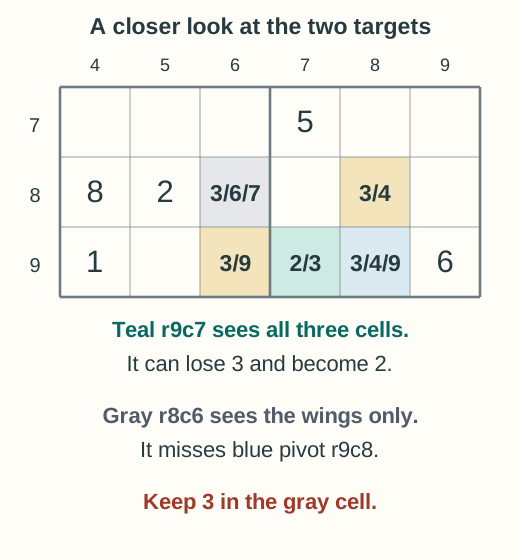
r8c6 does not see the pivot at r9c8. They occupy different rows, different columns and different boxes. If the pivot is 3, neither wing has to supply the 3 that would rule it out from r8c6.
There is a concrete consequence in this puzzle: the checked solution actually puts 3 in r8c6. Removing it would delete the correct candidate. This is why “the target sees both wings” is an incomplete check for an XYZ-Wing.
That check is sufficient for an XY-Wing, whose pivot has only two candidates and does not contain the shared elimination digit. Adding that digit to the pivot adds a third possibility you must account for. The names are similar; the target rule changes.
A manageable way to look for the pattern
Start with a cell that has exactly three candidates. Look among its peers for two-candidate cells using only those three digits. You need two different pairs that share one digit: for example, 3/4 and 3/9 around 3/4/9.
Before hunting for a removal, check both pairs really see the pivot. The wings do not have to see each other; in this example they do not. Then look for an empty cell that both contains the shared digit and sees all three pattern cells.
On this board, much of that checking happens near the bottom-right box and row 9. Treat that as a useful place to look, not a rule that every XYZ-Wing must have this orientation. Rotating the board changes its appearance without changing the row, column and box relationships.
If no cell contains the shared candidate in the required overlap, the pattern supplies no removal yet. Keep scanning elsewhere. And if an easier single is available, there is no reason to postpone it while searching for a named wing.
Check the two targets yourself
Use the unchanged starting grid in Figures 1 and 3. Before looking at the answer, explain the connections out loud or trace them with a finger.
Question 1. Which pattern cell rules out target 3 when the pivot is 4? Which unit connects it to r9c7?
Question 2. Why does the same argument fail for r8c6 when the pivot is 3?
Question 3. After the valid removal, what goes in r9c7?
Show the reasoning
1. r8c8 becomes 3. The pivot's 4 excludes 4 from this wing in column 8. Its 3 excludes target 3 through the bottom-right box.
2. r8c6 cannot see the pivot. A 3 at r9c8 does not conflict with a 3 at r8c6. Seeing the wings does not cover the branch in which the pivot supplies the shared digit.
3. r9c7 is 2. Its complete starting candidates were 2 and 3; all three pivot branches exclude 3 there.
Try checking those connections in a Sudoku practice game. If the candidate notation itself is still unfamiliar, use the Sudoku rules guide before looking for three-cell patterns.
Watch an XYZ-Wing explained
Sudoku Guy's Tutorial #42: the XYZ wing in a sudoku puzzle demonstrates the technique on a different board. Our figures use a separate practice position, so the cell coordinates will not match the video.
References
HoDoKu's wing reference explains the extra pivot candidate and the stricter elimination rule. Sudoku Coach's XYZ-Wing lesson contrasts that rule with a Y-Wing and walks through a contradiction proof. The grid, marked candidate lists and two-target comparison here were prepared and checked for this lesson.