
Three cells with the candidate pairs 5/6, 6/7 and 5/7 can remove a 7 from a fourth cell without deciding all three cells. In the practice board below, that removal leaves 3 as the only candidate at row 4, column 6.
This is an XY-Wing, also called a Y-Wing in Sudoku. The important part is which cells share a row, column or box. The shape need not look like the letter Y.
Locate the pivot and the two wings
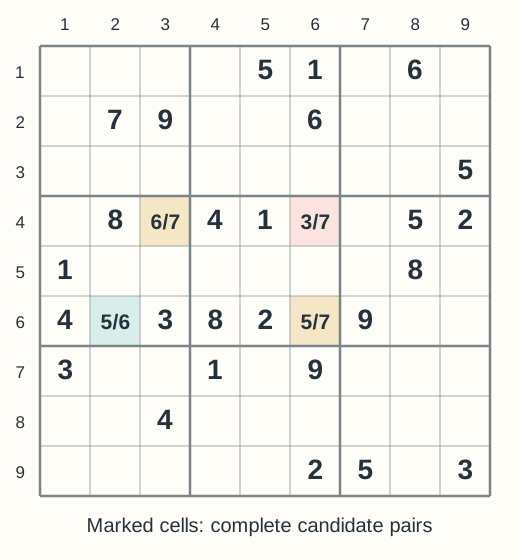
Look at row 6, column 2. It has only 5 and 6 available, making it the pivot. The two wings connect to it in different ways:
| Cell | Complete candidates | How it sees the pivot |
|---|---|---|
| r4c3 | 6, 7 | Same middle-left 3×3 box |
| r6c6 | 5, 7 | Same row, row 6 |
“Sees” means shares a row, column or box. The two wings do not need to see each other. Each shares a different pivot candidate, and both carry 7 as their other option.
The target, row 4, column 6, sees the first wing along row 4 and the second wing up column 6. It does not see the pivot. That is enough for an XY-Wing, because the target must see both wings, not all three pattern cells.
If you need a reminder of boxes and pencil marks, the Sudoku technique guide covers the basics. Every displayed pair in this practice position follows directly from the filled digits. There are no unshown earlier candidate removals.
Follow the pivot's two possible values
If the pivot is 5, the wing in row 6 loses its 5. With only 5 and 7 to choose from, that wing must be 7. The target cannot also be 7 in the same column.
If the pivot is 6, the other wing loses its 6 through their shared box. That wing must be 7 instead. This time the target loses 7 through their shared row.
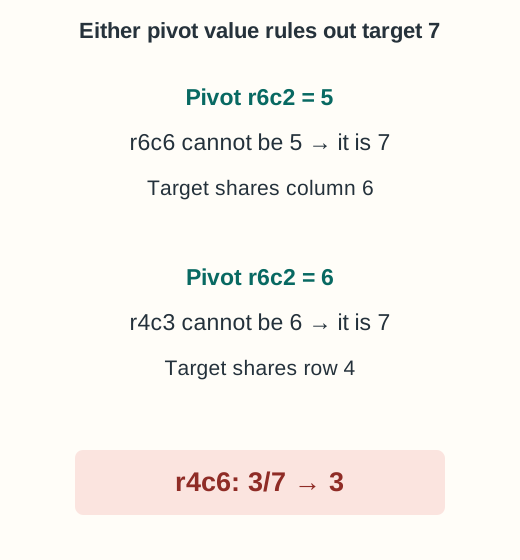
The pivot has no third candidate, so those cases cover its possibilities. Cross out the target's 7. Its complete notes were 3 and 7, which leaves r4c6 = 3.
Do not fill both wings with 7. The proof guarantees that at least one wing is 7. It does not tell you which wing, and the general pattern does not rule out both being 7 when the wings do not share a unit.
Check visibility before deleting another 7
A cell that sees only one wing does not get the same guarantee. Row 3, column 6 is a useful comparison on this board. Its candidates include 7, and it shares column 6 with the 5/7 wing. But it cannot see the 6/7 wing at r4c3.
When the pivot takes 6, that unseen wing provides the forced 7. The 5/7 wing could then be 5, so its column does not have to contain a 7 at that wing. This XY-Wing alone gives no reason to erase the 7 at r3c6.
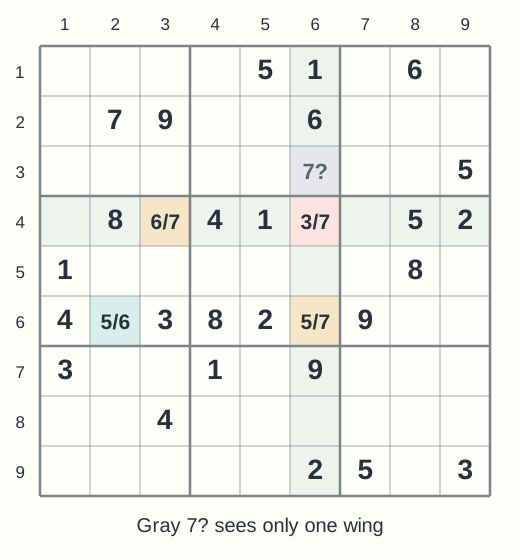
That distinction matters more than whether a cell lies inside a triangle drawn between the markers. Lines on the diagram show shared Sudoku units. Visual closeness or being “between” the wings is not a rule.
What makes a lookalike fail?
The three pattern cells must each have two current candidates. If a wing contains 5, 7 and 9, ruling out its 5 does not force 7. It could still take 9, so the branch is broken.
A pivot with a third candidate also needs a new argument. When that extra candidate is the wings' shared digit, you may be looking at an XYZ-Wing. Its target must see the pivot as well as both wings. Do not reuse the XY-Wing deletion just because two of the pivot's notes still look familiar.
Incomplete handwritten notes can create a fake pair. Before using this pattern, check that no legal candidate has simply been left off one of the three marked cells. You can practise with the notes on expert Sudoku, but the same pair checks apply to a paper puzzle.
Try the two branches yourself
In a separate schematic, the pivot is 2/8, one wing is 2/9 and the other is 8/9. Each wing sees the pivot. Cell T sees both wings and has notes 4/9. What can you place?
Show the answer
T is 4. A pivot value of 2 forces the 2/9 wing to 9. A pivot value of 8 forces the 8/9 wing to 9. Either way T cannot be 9. You still have not chosen the pivot's value.
Watch the pivot switch between its two values
Sudoku X's Y-Wing / XY-Wing lesson uses another board to animate the pivot and wings. Its example is separate from the original practice position above.
On a fresh Sudoku board, look for a cell with two candidates, then inspect the other two-candidate cells that see it. If no target carrying the shared wing digit sees both wings, this pattern has nothing to remove yet.
References
HoDoKu's XY-Wing reference defines the pivot, pincers and shared target. SudokuCoach's Y-Wing explanation follows the two pivot values. The practice board, marked cells and three figures here are original GridPuzzles material.