
Start with the small grid below. Ask your child to find the number missing from the top row, then check that number in its column and box. That gives you one placement to talk through before tackling a whole puzzle.
This practice grid uses 1, 2, 3 and 4. Each row, each column and each thick-bordered 2×2 box must contain all four numbers once. The printed clues stay where they are. A, B and C mark empty cells; they are labels, not extra symbols to place.
No addition is needed. A child can solve the first cell by pointing to the numbers already present. Conceptis's Sudoku rules describe these smaller 4×4 and 6×6 formats. The row, column and box checks also appear in Nikoli's classic Sudoku rules, though that larger format uses 1–9.
Give the first empty cell a reason
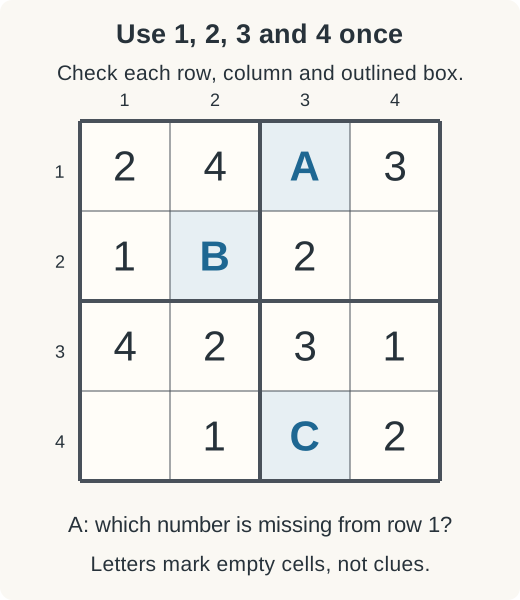
The top row reads 2, 4, A, 3. Of the four allowed numbers, only 1 is missing, so A = 1. Its column already contains 2 and 3; its top-right box contains 3 and 2. Neither prevents that 1.
If your child names 1 immediately, ask them to show where the other three numbers are. If they cannot choose yet, write 1, 2, 3, 4 beside the puzzle and cross off the numbers in that row. The remaining number is the one to check.
Keep the prompt tied to this cell: “Which number is missing here?” is more useful for the exercise than asking them to solve everything at once. There is no need to introduce a page of tiny candidate notes for a row with one gap.
A number can fit the row and still be wrong
B is a different kind of question. Its row contains 1, B, 2, empty, so the row is missing both 3 and 4. Looking only across the row does not settle B.
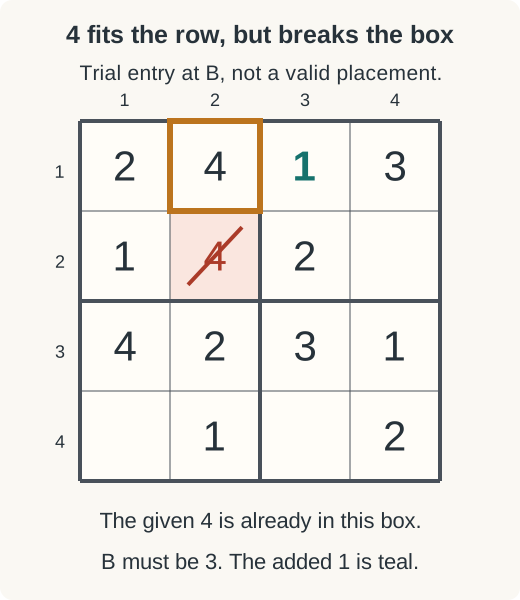
The printed 4 immediately above B rules out 4 twice: it is in the same column and the same top-left box. That leaves B = 3. Before filling it in, check that the row, column and box all allow 3.
This is a useful wrong answer to discuss. Instead of “No, try again,” ask, “Can you point to another 4 in this box?” The child has a visible reason to reject the trial, rather than a correction to memorise.
When an entry causes a duplicate, remove that entry and return to the clues. Do not erase a printed clue to make a chosen number fit. Our diagram deliberately shows one bad trial so you can compare it with a legal placement.
Let them finish the small grid
With A filled as 1, look down the third column: 1, 2, 3, C. What must C be? Then finish the two unlabelled gaps. Have your child check the boxes as well as the rows before opening the answer.
Check the completed 4×4 puzzle
C = 4: it completes the third column. The remaining gaps are row 2 column 4 = 4 and row 4 column 1 = 3.
| Row | Column 1 | Column 2 | Column 3 | Column 4 |
|---|---|---|---|---|
| 1 | 2 | 4 | 1 | 3 |
| 2 | 1 | 3 | 2 | 4 |
| 3 | 4 | 2 | 3 | 1 |
| 4 | 3 | 1 | 4 | 2 |
Each row, column and 2×2 box contains 1–4 once. The original clues have not changed.
If you want more paper puzzles at these sizes, KrazyDad's Kidoku collection offers 4×4 and 6×6 sets. The diagrams in this article are our own practice positions, not copied from that collection.
Try six numbers without changing the checks
For a next exercise, use 1–6 and boxes that are two rows high and three columns wide. Trace one thick-bordered box before filling a cell; a 6×6 grid does not have the 2×2 boxes from the earlier example.
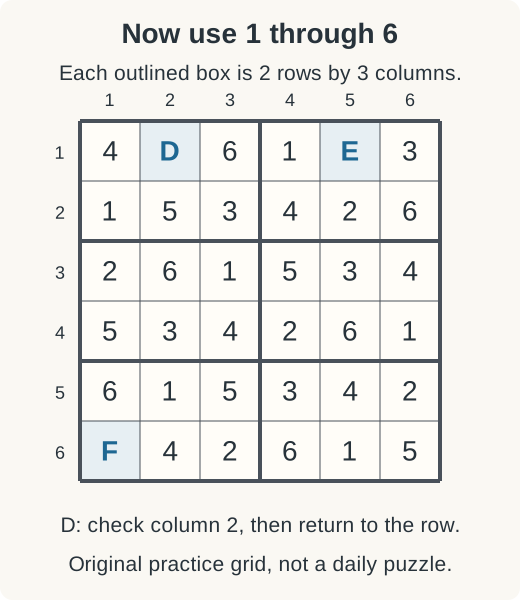
Start with D. Its column contains 5, 6, 3, 1 and 4, so D = 2. Now the top row reads 4, 2, 6, 1, E, 3. Only 5 is missing: E = 5. Leave F for your child, with the same request to explain the choice.
F = 3, because the bottom row already has 4, 2, 6, 1 and 5. Its column and bottom-left box also allow 3. This nearly completed grid is a short exercise in carrying the checks across; it does not mean every 6×6 puzzle has such direct moves.
Clarity Media's video below works through a different 6×6 puzzle with the same box shape. It can help with the move to six numbers; it does not solve our 4×4 example.
Watch Really Useful Method for Solving 6x6 Sudoku Puzzles by Clarity Media on YouTube.
GridPuzzles' Mini Sudoku is a playable 6×6 game with these 2×3 boxes. The 4×4 grid above is an article exercise, not a separate game on this site. You can check the Mini Sudoku rules or choose another board in unlimited Mini Sudoku.
On a less-filled board, a cell may still have two possible numbers after all three checks. Leave it empty and look elsewhere. A useful placement is one you can explain from the clues; finishing a row by guessing gives you less to build on for the next move.