Use 1 through 6, with each digit appearing once in every row, column and outlined box. For the Mini Sudoku game on GridPuzzles, a box is two rows tall and three columns wide. That rectangle is the first thing to check if you are used to 9×9 Sudoku.
Knowing the rules does not always make the first empty cell obvious. The practice grid below gives you three moves to follow: combine a row with a column, find a digit's only place in a box, then use that placement to settle another cell. Each move has a reason you can check before entering the number.
Is a 6×6 box 2×3 or 3×2?
You may encounter either orientation. The short notation can be confusing because a writer may name the height first or the width first. Count the rows and columns inside the thick border rather than relying on the label alone.
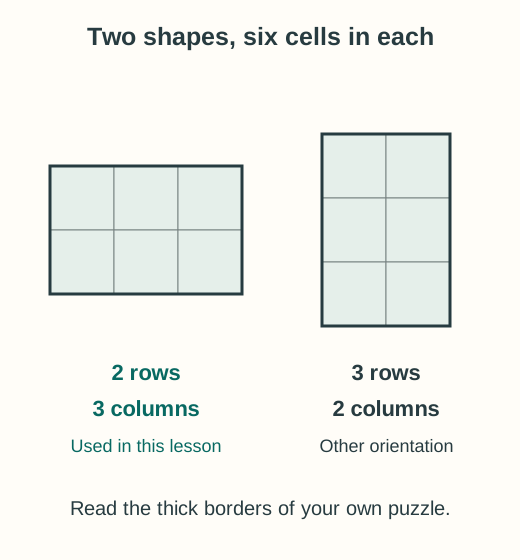
This lesson uses two-row, three-column boxes throughout. On its full 6×6 board, the vertical box boundary falls after column 3, and the horizontal boundaries fall after rows 2 and 4.
A puzzle with three-row, two-column boxes has different boundaries. Follow the ones actually drawn. Do not enforce both layouts on one puzzle unless its instructions specifically ask you to.
The other rules stay straightforward: keep the supplied clues fixed, use no 0, 7, 8 or 9, and check the row, column and box together. A number fitting in one of those places is only part of the test.
Start with this practice grid
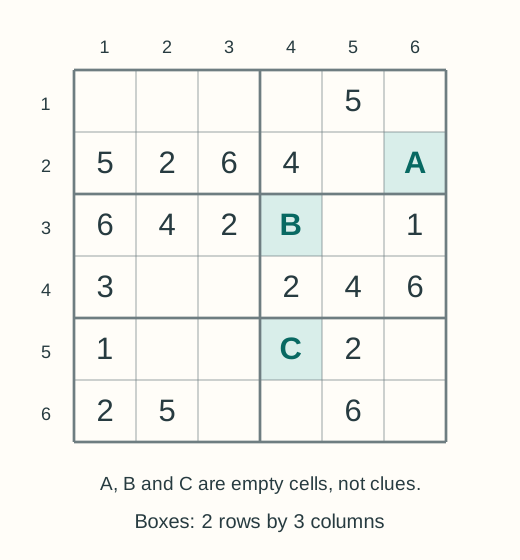
Coordinates such as r2c6 mean row 2, column 6, counted from the top left. The clues and solution were checked for this lesson. This is a practice puzzle, so it will not match today's daily game.
Move A: the row offers two digits, the column chooses one
A is r2c6. Row 2 already contains 5, 2, 6 and 4. It needs 1 and 3, but there are two blanks; that alone does not tell you which goes in A.
Now look down column 6. Its given clues include 1 at r3c6 and 6 at r4c6. A cannot be 1, so the row's only remaining choice for it is 3. The top-right box has no 3 to contradict that placement. Put 3 in A.
This is a small but useful habit: list the missing digits in a promising row, then test them against the crossing column and the box. You do not need a row with five clues before you can place anything.
Move B: a cell allows two digits, but the box needs a 5
B is r3c4, in the middle-right box. That box spans rows 3–4 and columns 4–6. Its four supplied numbers are 1, 2, 4 and 6, so its two blanks must take 3 and 5.
The blanks are r3c4 and r3c5. Column 5 already contains 5 at r1c5, which prevents r3c5 from taking 5. That leaves B as the box's only place for 5. Put 5 in B.
Inspected alone, B allows both 3 and 5. You did not prove its value by finding a lone candidate in B; you proved where the box's 5 must go. This is a hidden single. It uses the same row, column and box rules as the first move, but asks a different question.
Move C: return to the column you just changed
Before B was filled, C at r5c4 allowed 3 or 5. B has now placed a 5 in column 4. Cross 5 off C's possibilities; 3 is the only one left. Put 3 in C.
There is no conflict between A and C both being 3. They do not share a row, column or box. A digit can appear several times across the whole board; it must appear only once within each individual unit.
The useful follow-up to a placement is nearby. Recheck its row, column and box before scanning the entire grid again. Here, the box move at B immediately settled C in the same column.
Your turn: find D after those three moves
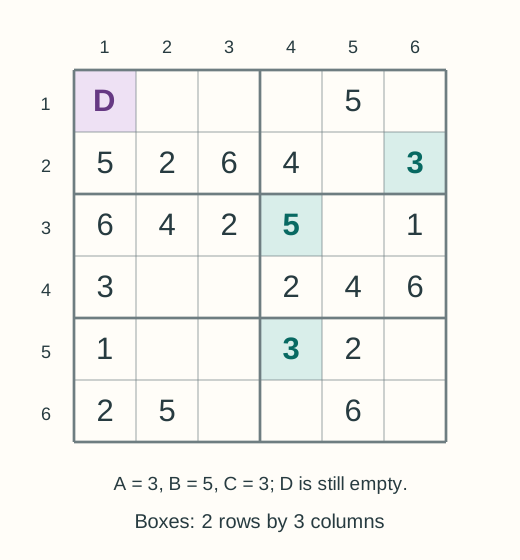
D is r1c1. Its row has many blanks. Rather than choosing a number that seems to fit the row, inspect column 1. Which digit is missing, and does D's box permit it?
Show D's reasoning and the checked solution
D is 4. Column 1 already contains 5, 6, 3, 1 and 2, leaving only 4. Neither row 1 nor the top-left box already contains a 4, so it fits all three constraints.
You can continue from Figure 3 before checking the finished grid below. The column proof for D did not depend on filling the whole puzzle first.
| Row | c1 | c2 | c3 | c4 | c5 | c6 |
|---|---|---|---|---|---|---|
| 1 | 4 | 3 | 1 | 6 | 5 | 2 |
| 2 | 5 | 2 | 6 | 4 | 1 | 3 |
| 3 | 6 | 4 | 2 | 5 | 3 | 1 |
| 4 | 3 | 1 | 5 | 2 | 4 | 6 |
| 5 | 1 | 6 | 4 | 3 | 2 | 5 |
| 6 | 2 | 5 | 3 | 1 | 6 | 4 |
When the next move is not obvious
An empty cell allowing two digits is unfinished information. Write both as notes if that helps, then look elsewhere for a placement that rules one out. Move C is an example of why leaving a pair unresolved can be productive.
Do not use a total of 21 as a substitute for checking repeats. Although 1+2+3+4+5+6 is 21, the row 1, 1, 4, 4, 5, 6 also adds to 21 and breaks the rules. Sudoku asks for each digit once, not just the right sum.
If a cell has no possible digit, revisit earlier entries and the box borders. If several candidates remain, that alone is not evidence of a mistake. A smaller grid gives you fewer digits to track, but it does not make every blank immediately decidable.
For another board, open unlimited Mini Sudoku. Try making one placement at a time and naming the reason: “the column is missing 4” or “5 has only one place in this box.” The Mini Sudoku rules guide explains the game's controls if you need help entering numbers or notes.
Watch another 6×6 solve
Clarity Media's Really Useful Method for Solving 6x6 Sudoku Puzzles uses a different six-by-six board with the same two-row, three-column boxes. It provides another visual example of looking for placements; the numbers and coordinates will not match this practice grid.
References
Conceptis's Sudoku rules includes Mini Sudoku's 1–6 rule. Its techniques guide explains scanning rows and columns and finding single candidates, using 9×9 examples. The 2006 World Sudoku Championship instruction booklet, page 6, explicitly includes both box orientations for Mini Sudoku. The figures, three-move sequence and exercise here use a separate checked practice grid.