A Pips region can have the right total while the domino that completed it is still wrong. The other half may break the next region, or leave a hole that no remaining piece can reach.
Before placing a tile, check the value you need, its attached partner, and the space both halves occupy. Here is a small position where that makes the difference between a tempting move and a forced one.
If the symbols are unfamiliar, start with the Pips rules and worked examples. This lesson assumes you know how sums work and focuses on deciding between placements.
Two tiles left, four empty cells
The practice board below is 4×4. Six dominoes are already placed and stay fixed for this exercise. You have two left: 5–6 and 4–5. Every labeled region wants an exact sum; the letters are names for the regions, not extra rules.
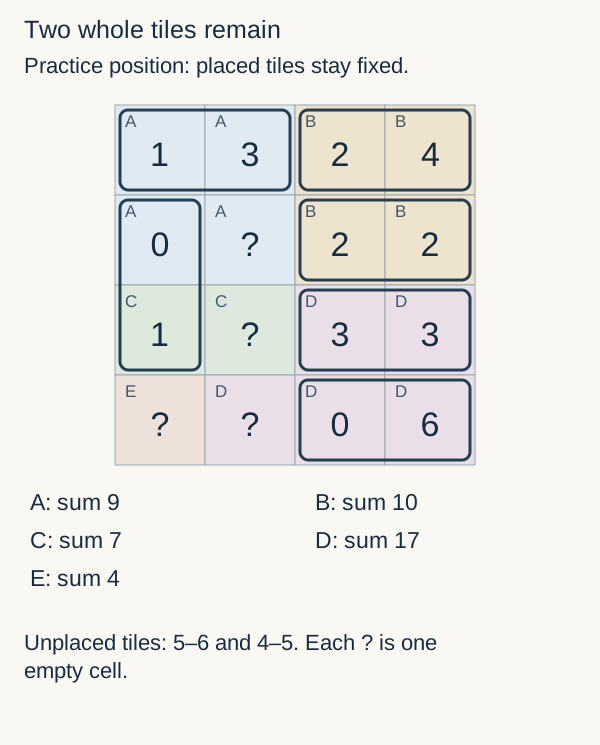
Figure 1. The top-left region needs a 5. Both remaining dominoes contain one, so that fact alone does not choose a tile.
Rows run from top to bottom and columns from left to right. The holes are r2c2, r3c2, r4c1 and r4c2. Here is the arithmetic before you move:
| Region | Target | Pips already placed | Still needed |
|---|---|---|---|
| A: top-left four cells | 9 | 1 + 3 + 0 = 4 | 5 in r2c2 |
| B: top-right four cells | 10 | 2 + 4 + 2 + 2 = 10 | Nothing; complete |
| C: r3c1 and r3c2 | 7 | 1 | 6 in r3c2 |
| D: five cells along the lower right | 17 | 3 + 3 + 0 + 6 = 12 | 5 in r4c2 |
| E: r4c1 alone | 4 | 0 | 4 in r4c1 |
In E, “0 already placed” means the region is empty. It is not a placed zero-valued domino half.
Why filling the 9 first can lead you astray
Region A needs 5, so it is tempting to put the 5 end of 4–5 into its remaining cell. The only empty cell beside it is r3c2, so the other end would have to put 4 there.
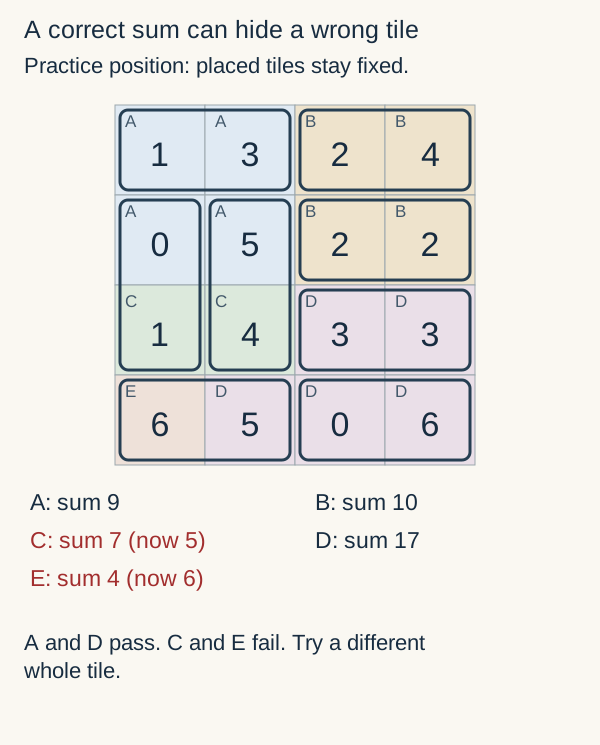
Figure 2. A reaches 9, but C becomes 1 + 4 = 5 instead of 7. The remaining 6–5 also leaves E at 6 instead of 4.
The move fails even though the region you were watching is correct. Rotating the same tile does not rescue it: that would put 4 into A, which needs 5.
This is a useful check while solving: say what both ends would do before dropping the tile. “Five finishes A” is half a reason. “Five finishes A and six finishes C” accounts for the whole domino.
You do not need to make a speculative move here. Region C already tells you which partner A's 5 must have.
Start with the constraint that chooses a piece
Region E is a single cell with target 4. Of the two remaining tiles, only 4–5 contains a 4. Its only available neighbor is r4c2, so the tile must lie horizontally: 4 in E, 5 in D.
That leaves 5–6 for the vertical gap. A needs its 5, and C needs its 6. All five sums now work.
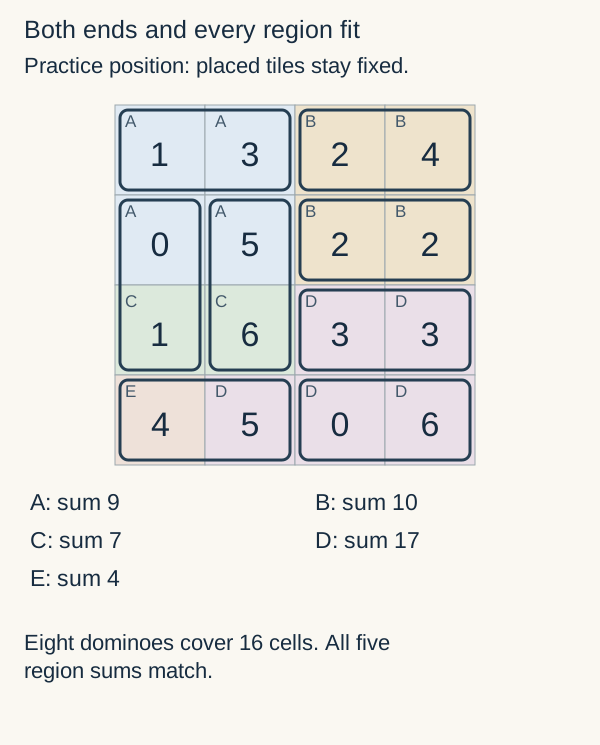
Figure 3. The solution uses eight whole dominoes, covers all sixteen cells, and satisfies sums 9, 10, 7, 17 and 4.
E was the useful starting point because it selected a particular remaining tile and its direction. A selected only a number shared by two tiles. On another board, a tight equals region or a large required sum might be the stronger restriction. A small region is not automatically the best one; look for the constraint that removes choices.
Three checks worth making on the next board
Count the tiles you actually have
If a three-cell equals region must contain three 4s, count the available 4 ends before reserving them. A double 4–4 contributes two 4 ends. A single 4 on a 4–6 contributes one, and its 6 still needs somewhere legal to go.
The same applies to small sums. A region needing 1 may suggest a 1 with zeros, but that arrangement is unavailable if the rack has no usable zero ends. Work with the supplied pieces rather than an imagined complete domino set.
Keep strict inequalities strict
In a region marked <5, a completed sum of 5 fails. The largest allowed total is 4. A >3 region needs at least 4. Zero is a legitimate pip value; a blank half is not a missing tile.
For an unfinished sum region, subtract the pips already inside it. Then consider the remaining cells together with the ends you can actually bring to them. A possible arithmetic total is a starting point, not proof that those pieces fit.
Check the empty space, not just the colored regions
A region can contain an odd number of cells because a domino may cross its boundary. An isolated empty pocket with an odd number of cells is different: if all its routes out are blocked by fixed tiles or the board edge, two-cell dominoes cannot fill it without moving something.
For example, a three-cell pocket with no empty neighbor outside it cannot be tiled by whole dominoes. One placement covers two cells and strands the third. This check concerns connected empty space, not the region's color or target.
It is especially useful when a placement makes a neat sum but splits the remaining holes into awkward groups.
A short practice check
Return to Figure 1 without filling anything. Suppose you begin at C instead of E. C has one placed pip and needs a total of 7, so its empty cell needs 6. Which tile and direction follow?
Show the reasoning
Only 5–6 has a 6. The 6 must go in r3c2, but that cell has two empty neighbors: r2c2 above and r4c2 below. If its 5 went below, the two remaining holes would be r2c2 and r4c1. Those cells are not adjacent, so the remaining 4–5 could not cover them. The 5 must therefore go above, completing A. The remaining 4–5 lies across r4c1–r4c2, with 4 in E and 5 in D. This reaches the same solution from a different forced constraint.
Try that two-end check in a Pips practice game. On the next uncertain placement, identify the second region or empty pocket it affects before committing to it. You are looking for a reason the whole piece belongs there, rather than a reason one half looks promising.
See the game in motion
TODAY's New York Times Reveals New Game ‘Pips:’ How It Works shows the board and placement mechanics. The practice position in this article is original and does not reproduce a daily puzzle.
References
The rules section of Alberti and colleagues' study of NYT games describes covering the board while meeting region constraints. The GridPuzzles rules guide covers the symbols used on our site. All coordinates, tile choices and arithmetic in this lesson refer to the original fixed practice position above.