
In row 3 of the puzzle below, 3, 4 and 7 can go in only three cells. Those cells are reserved for them. Remove 1 and 5 from r3c2, and remove 8 from r3c5. You haven't placed a number yet, but the crowded notes are smaller.
The awkward part of a hidden triple is finding it. One of those cells starts with five candidates, so looking only for small groups of notes can miss the useful pattern.
List where each missing digit can go
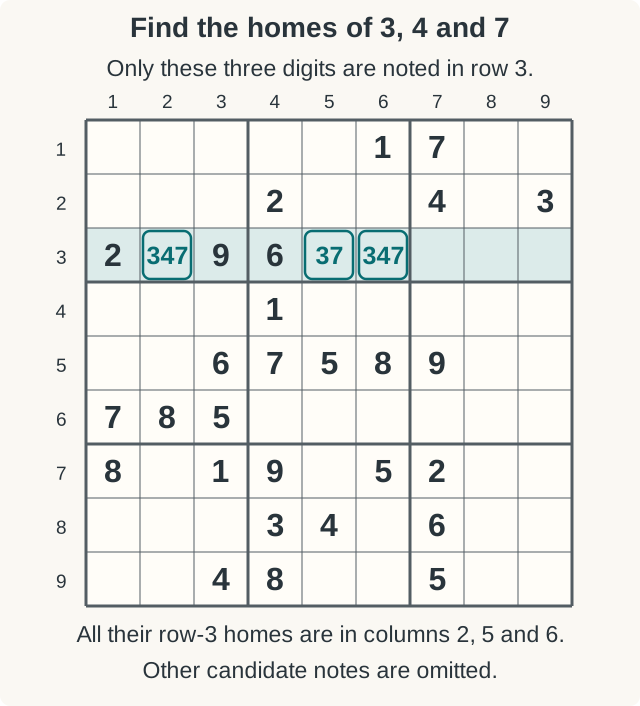
Row 3 already contains 2, 9 and 6. Its six empty cells still need 1, 3, 4, 5, 7 and 8. Follow the possible locations for three of those missing digits:
| Digit | Every possible location in row 3 |
|---|---|
| 3 | r3c2, r3c5, r3c6 |
| 4 | r3c2, r3c6 |
| 7 | r3c2, r3c5, r3c6 |
Across all three lines of the table, only columns 2, 5 and 6 appear. The row needs a 3, a 4 and a 7, and each must occupy a different cell. Three required digits have three available cells between them. There is no spare cell for a different digit in that group.
Notice that r3c5 has no candidate 4. That's fine. The three digits don't have to appear in every one of the cells. What matters is that every possible location for the three digits, within this row, stays inside the same three cells.
Clear the extra notes inside the group
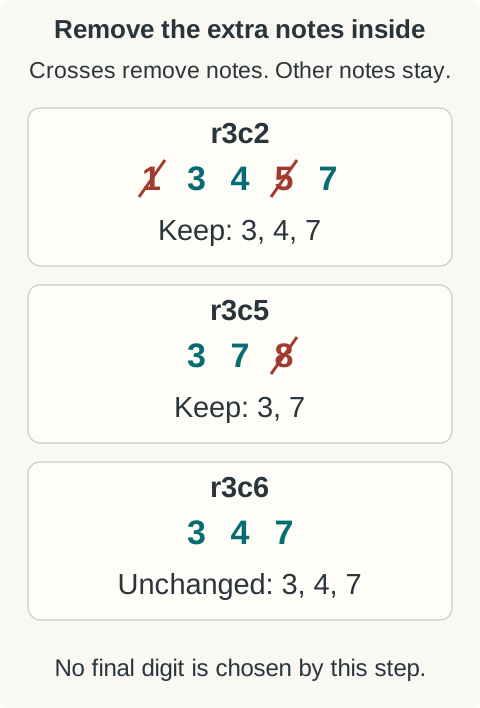
The 1 and 5 in r3c2 would each use a place needed by 3, 4 or 7. Cross them out. For the same reason, r3c5 loses its 8. Keep both its 3 and its 7. The triple doesn't decide between them.
Leave the 3, 4 and 7 notes in the group alone unless another deduction removes one. Finding three repeated digits is not permission to choose a favorite arrangement. Here, r3c6 has no extra candidates to remove at all.
This search depends on complete candidate notes. If you leave out a legal 3 in another cell of the row, the group can look confined when it isn't. If a digit has only one possible location, use that hidden single directly before searching larger groups.
The same row offers another way to see it
Look at the three remaining empty cells: r3c7 has 1,8; r3c8 and r3c9 each have 1,5,8. Together, their candidates use only three digits. That's a naked triple for 1, 5 and 8, and it removes those digits from the other empty cells in the row. You reach the same three removals.
The direction of the search changes. For the hidden triple, you tracked where three digits could go and cleared other notes from their cells. For the naked triple, you inspected the full notes in three cells and cleared their digits from the rest of the row. On this board, the smaller candidate lists on the right may be easier to notice.
Check the whole unit before calling it a triple
The following exercise is a separate candidate-only sketch. Its letters name four cells in one row, not coordinates in the puzzle above.
Suppose A has 1,3,4,7, B has 3,7, C has 3,4,7, and D has 1,3. Can you reserve A, B and C for 3, 4 and 7, then erase 1 from A?
Show the counterexample
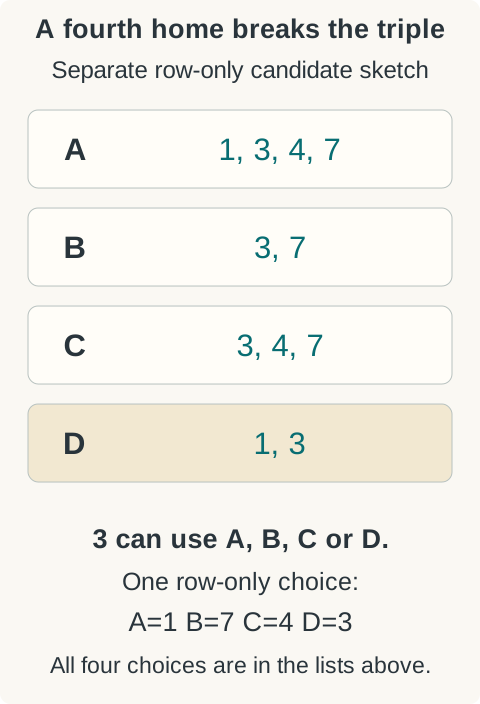
No. Digit 3 can also go in D. The combined locations of 3, 4 and 7 now cover four cells, so three cells are not reserved for them. For example, A=1, B=7, C=4 and D=3 fits every displayed candidate list and repeats no digit. Erasing A's 1 would reject that valid local possibility.
The unit can be a row, a column or a 3×3 box. Keep that boundary fixed while checking locations. In a Hard Sudoku, try listing the positions of a few missing digits in one busy unit. A valid hidden triple clears other candidates from its three cells. It doesn't clear those candidates from unrelated cells elsewhere on the board.
Watch the candidate cleanup
Watch Sudoku.com's hidden-triples lesson on YouTube. It demonstrates a different example in a box. Watch which notes stay in the reserved cells and which are removed.
References
HoDoKu's hidden-subsets reference explains how reserved digit positions justify the removals. Sudoku.com's hidden-triples lesson illustrates clearing extra notes in a box. The puzzle, row comparison and counterexample above are original.