Dordle is a close starting point if you want Wordle's five-letter clues with more than one answer to find. You enter one word, and two boards score it separately. If finding English words is the part you'd like to leave behind, choose a different kind of target: an equation in Nerdle or a country outline in Worldle.
| What you want to do | Try | What changes |
|---|---|---|
| Keep five-letter words and learn to read two sets of clues | Dordle | Two answers share seven guesses |
| Add another answer without jumping to a large grid | Tridle | Three boards, eight shared guesses |
| Keep track of many partly solved words | Sedecordle | Sixteen boards share twenty-one guesses |
| Work out digits and arithmetic signs | Classic Nerdle | Guess a valid eight-character equation |
| Recognise a place from its outline | Worldle | Use a silhouette, distance and direction |
The board counts and guess limits here describe the GridPuzzles versions of the three word games. Nerdle and Worldle are separate sites, linked below.
More word boards: one entry, separate clues
In a multi-board game, a useful guess need not fit every answer. It is sent to each unsolved board, which judges it against its own word. A letter can be absent from one answer and essential to the other.
Here is an original practice position with the answers exposed so you can check the colours. The guess is CRANE. Board A hides PLAIN. Board B hides BRICK. These are practice words, not today's answers.
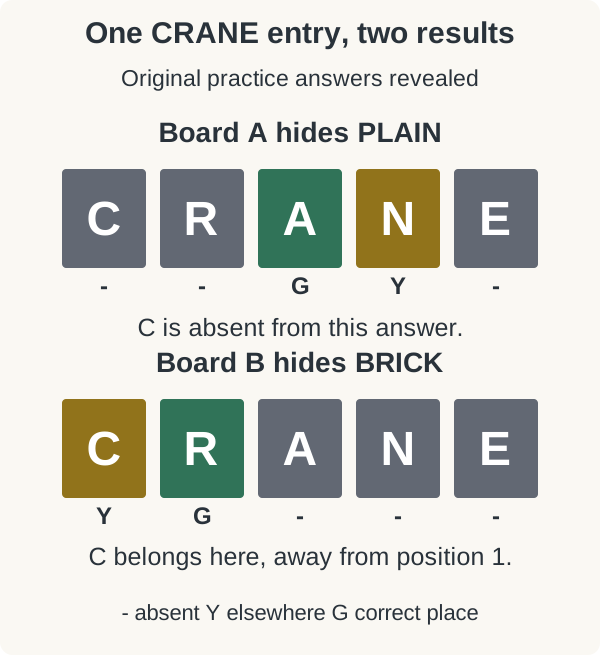
On Board A, A is already in the third position. N belongs somewhere other than the fourth position. C is absent. On Board B, the yellow C says the opposite about that letter: keep C, but move it away from the first position. R is fixed in second place.
You cannot combine those two C clues into a single verdict for the whole game. Discarding C everywhere would remove BRICK from consideration even though it is the right-hand answer. Keep a separate set of possible words for each board.
When you enter an answer, that board is finished. The remaining boards still use the same guess counter. In this example, entering PLAIN as your second guess would solve Board A and leave five guesses for Board B. It would not start a fresh seven-guess round.
An opening word can provide clues on both boards without being either answer. The Wordle first-guess comparison works through what SLATE can reveal and what a ranking cannot promise. The original Dordle by zaratustra is a separate implementation, so its presentation differs from GridPuzzles.
A video look at Dordle
Supreme Guru Tech's What Is Dordle and How to Play Dordle on your Phone shows the original game's two-board format. Use it to see a shared entry reach both boards. The phone interface in the video is not the GridPuzzles interface.
Two boards or sixteen?
Tridle adds a third word. It gives you another set of clues to compare without requiring you to scan sixteen positions after each entry. Sedecordle is the larger step: a guess can tell you something about many words, but you also have to notice which board now has enough evidence to solve.
The larger number of allowed guesses can be misleading. Suppose every answer is different and each must be entered once. Subtract those required answer entries from the total:
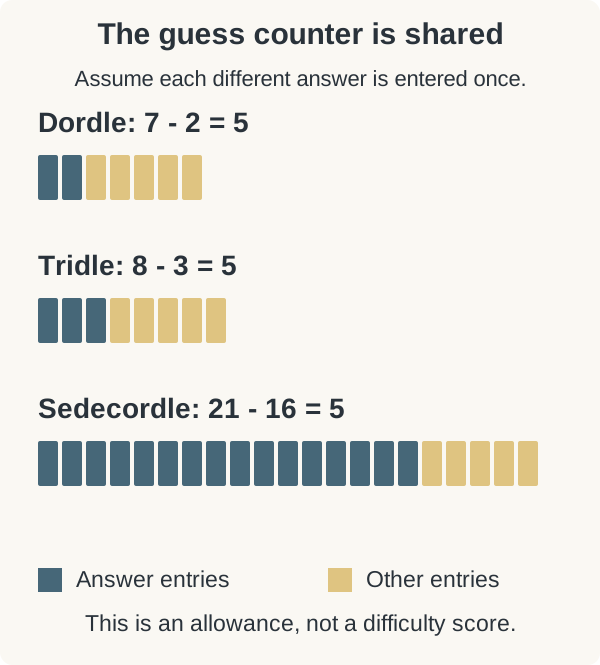
All three calculations leave five entries beyond the answers themselves. That does not make the games equally difficult. A single guess may help several boards, and an answer entered for one board can reveal useful letters on the others. Sixteen boards also ask you to manage much more information. The subtraction explains the allowance, not your chance of winning.
If two sets of clues already feel hard to separate, stay with Dordle for a few games. Move to more boards when you want more scanning, rather than expecting a bigger total to give each individual word more room.
Classic Nerdle: keep the clues, change the alphabet
Classic Nerdle gives you six guesses at an eight-character calculation. Digits, operators and the equals sign all occupy positions. A guess must be a true equality, not just eight characters that might uncover useful symbols.
Consider 8*3-4=20. It uses eight characters, including the two separate digits in 20. Multiplication comes before subtraction, so the left side is 24 minus 4, which equals 20.
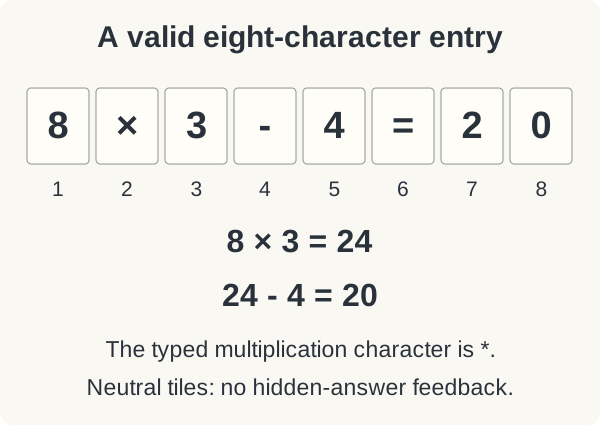
Nerdle's official rules use green for the right character in the right position and purple for a character needed elsewhere. Extra copies of a repeated character can be gray. Try this if testing arithmetic sounds more appealing than searching for another five-letter word. This diagram checks an entry, not a proposed best opening or a daily solution.
Worldle: interpret the arrow from your guess
Worldle starts with the silhouette of a country or territory. You have six attempts. After a wrong guess, the distance and arrow help you choose another place.
The arrow points from the place you guessed toward the target, according to the official FAQ. It is not a direction from your own location. Distances are measured between the places' centres, so two countries that share a border need not show a distance near zero.
The silhouette has no scale. An outline that fills the picture is not necessarily a large country, so use the distance as well as the shape when deciding what to try next.