
If you want a familiar word to start with, SLATE is a reasonable choice. It tests five different letters, including two vowels, and is easy to remember. That is a practical recommendation, not a claim that it is the mathematically best opener for every current Wordle game.
You may also have seen SALET at the top of solver rankings. Alex Selby's published analysis identifies it as optimal for the original word lists under its average-guesses objective. His project explicitly warns that those original-list results should not be confused with the later default word list.
The distinction matters more than the order of two letters. A useful opening guess divides the possible answers into groups you can work with. What you do with the feedback decides whether that information is useful.
An opener tests possibilities, not just letters
Consider this deliberately tiny practice list of eight possible answers:
CLOVE, STARE, PLATE, SLATE, STEAL, STALE, TABLE, CRANE
It is not the current Wordle answer list, and the words are treated as equally likely only for this exercise. Guess SLATE against each one:
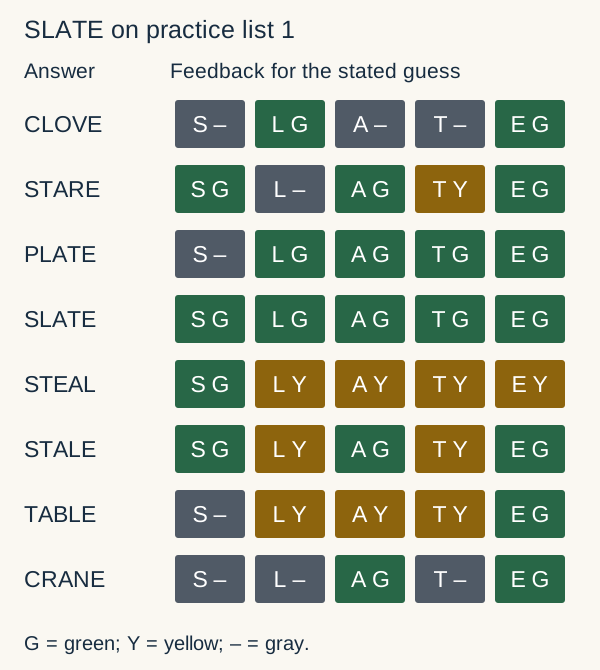
Figure 1. A guess produces a pattern of five clues. Answers giving the same pattern remain indistinguishable after that guess.
SLATE gives eight different feedback patterns on this list. STARE and STALE look similar, but SLATE's L is gray against STARE and yellow against STALE. That one tile separates them. With this restricted list, the complete pattern identifies the answer.
The point is to keep all five clues together. A green tile fixes a position. A yellow tile keeps a letter but rules out the guessed position. Repeated letters add a count restriction. Reducing a row to “I found three letters” discards information you have already paid a guess to obtain.
Why a vowel-heavy word is not automatically better
ADIEU checks four different vowels. It can be useful, but the number of vowels tested is not the same as the number of answers separated.
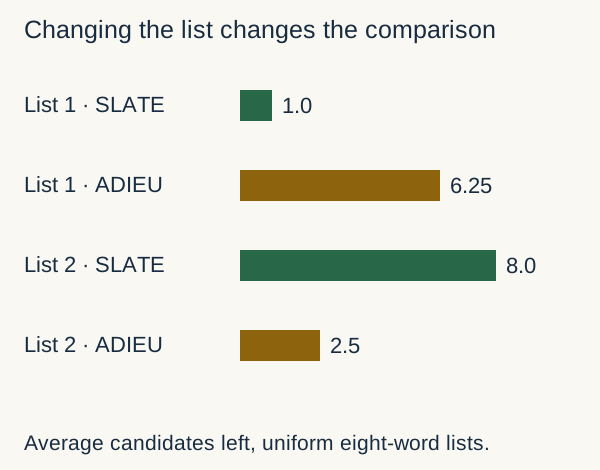
Figure 2. These results describe this eight-word exercise only. They are not a ranking over the real Wordle dictionary.
To read the comparison, imagine the answer is chosen uniformly from the eight words. For each possible feedback pattern, count the answers still consistent with it. A group of three is encountered three times as often as a group of one. The average number left is therefore the sum of the squared group sizes divided by eight.
On that list, SLATE leaves an average of 1 answer and ADIEU leaves 6.25. ADIEU puts seven of the eight answers into the same feedback group.
Now change the practice list to CHIRP, CHUMP, MOUND, ROUND, BRICK, PRICK, DRINK and DRUNK. SLATE contains none of their letters, so every answer gives five grays. ADIEU separates them into smaller groups. Figure 2 includes that reversed comparison too.
These lists were constructed to make the distinction visible. Neither represents today's answer distribution. A list of selected examples can demonstrate how feedback works; it cannot establish a current global winner between SLATE, ADIEU or another opener.
This is the intuition behind information-based Wordle explanations such as Grant Sanderson's 3Blue1Brown lesson. A solver that minimizes total guesses also has to consider what happens after the first row, including whether a guess can itself be the answer.
Do not follow a fixed second word blindly
An opening routine such as “always play two words before thinking” is convenient, but it can spend a turn testing letters your first row has already settled.
After SLATE, first write down the actual restrictions. Keep the greens, move the yellows, and exclude grays with the usual duplicate-letter care. Then choose the next guess for the remaining possibilities. Sometimes that means trying a likely answer immediately. Sometimes it means testing a letter that separates several similar answers.
A planned second word can still be useful when the first row reveals little. It should earn its place from the clues you received, rather than from a memorized sequence alone.
When an information guess beats another hopeful answer
Suppose the remaining answers are exactly CATER, HATER, LATER and WATER. You know the ending but have not identified the first letter.
Guessing CATER can win immediately. If it is wrong, however, HATER, LATER and WATER all give the same feedback for that guess. You have used a turn without separating those three.
In normal mode, WHELP can distinguish all four possibilities:
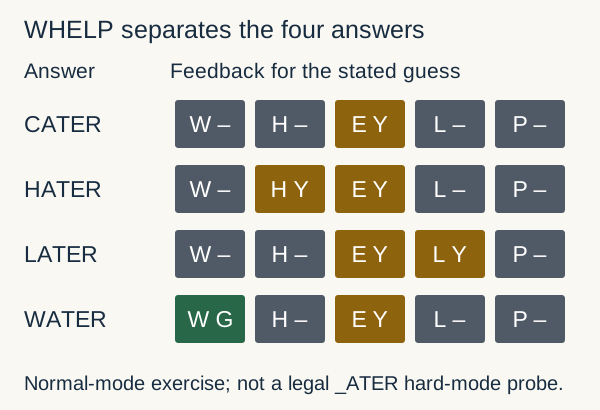
Figure 3. WHELP cannot be an answer from the four-word list. It tests the unresolved first letters and gives four different outcomes.
That probe uses one guess, then leaves a known answer for the next. If you have only two guesses left and those are truly the only candidates, it guarantees a finish within this small model. Guessing the candidates one at a time cannot offer that guarantee.
This is not a hard-mode recommendation. WHELP does not preserve the established _ATER positions, so it would be illegal when those positions must be reused. In hard mode, the allowed guesses and the best decision can differ.
It is also not a reason to probe forever. If only one answer remains, enter it. With two candidates and enough turns, trying one can be perfectly sensible. The value of an information guess comes from the uncertainty it removes and the turns it leaves you.
Taking the idea to two boards
Dordle gives the same guess to two separate answers. A word that tests a useful consonant on one board can reveal a vowel position on the other. You must still read each board's feedback separately.
Use a familiar five-letter opener, then inspect both rows before choosing another word. Do not keep probing a nearly solved board while ignoring that the other board still has several distinct possibilities. A shared guess has a cost as well as a possible benefit: it uses one of the common turns.
Tridle adds a third board. The principle stays the same, but a Wordle ranking calculated for one answer is not automatically an optimal multi-board strategy.
What to check when someone calls a word “best”
Look for three details: which answer list, which mode, and which objective. “Most information on the first row,” “fewest guesses on average,” and “guaranteed finish within a limit” ask different questions.
For ordinary play, a consistent opener such as SLATE is enough to start learning from the feedback. The useful habit is to change your next guess when the clues change. A ranking cannot make that decision for a different board.
Watch the analysis behind the rankings
3Blue1Brown's Oh, wait, actually the best Wordle opener is not ‘crane’… revisits an earlier analysis. It is a useful companion for seeing why a modeling choice can change an opening-word recommendation.
Sources and limits
Alex Selby's Wordle project distinguishes original and extended word lists and publishes the analysis behind its results. Grant Sanderson's original lesson and follow-up explain the information argument and its revision. The eight-word and four-word exercises here are constructed teaching examples, not measurements of current NYT answers or a promise of a winning streak.