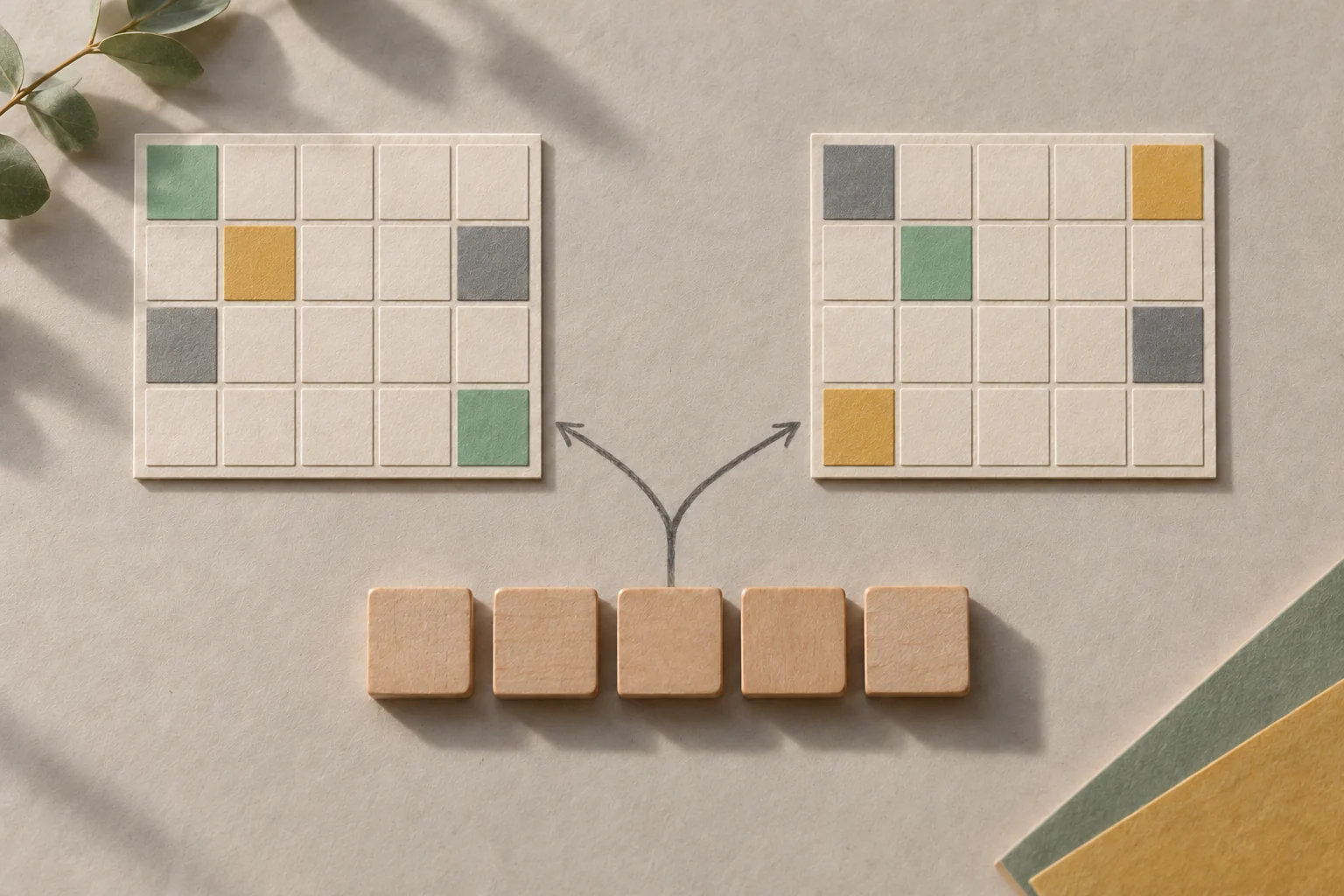
Before entering a Dordle guess, ask what its feedback could change on each board. A word that tests three possible answers on the left and three on the right can be worth more than a hopeful guess at one answer. But it still costs a turn, so you need enough turns left to enter the answers afterward.
GridPuzzles Dordle gives you seven shared guesses to solve two five-letter words. You do not get seven guesses per board. A solved board fades and stops accepting guesses; the remaining board uses whatever is left of the same allowance.
The practice positions below use invented shortlists, not daily answers. They show how to compare moves when you already understand green, yellow and gray tiles.
Keep two sets of clues
A guess goes to both open boards, but each board scores it against its own answer. A gray C on the left cannot eliminate C on the right. The split keyboard helps you keep track, though a full row tells you more about positions and repeated letters than the keyboard alone.
For example, if you guess two Es and get one green and one gray in the same row on one board, the answer has exactly one E: the green copy is present, and the gray copy is extra. A green E in one turn and a yellow E in another may refer to the same E. Do not add them together to invent a second copy.
Once you have possible words, compare the words themselves. Testing another vowel is useful only if its different outcomes could separate answers you still consider possible.
A candidate can leave the other board unchanged
For this drill, assume these shortlists are complete and you have three guesses left, with neither board solved:
| Left board | Right board |
|---|---|
| BATCH, CATCH, WATCH | LIGHT, MIGHT, NIGHT |
We are comparing the next move from those assumptions, rather than reconstructing a whole game's earlier rows.
Guessing CATCH might solve the left. If it does not, its feedback leaves BATCH and WATCH together. On the right, CATCH produces exactly the same feedback for all three words.
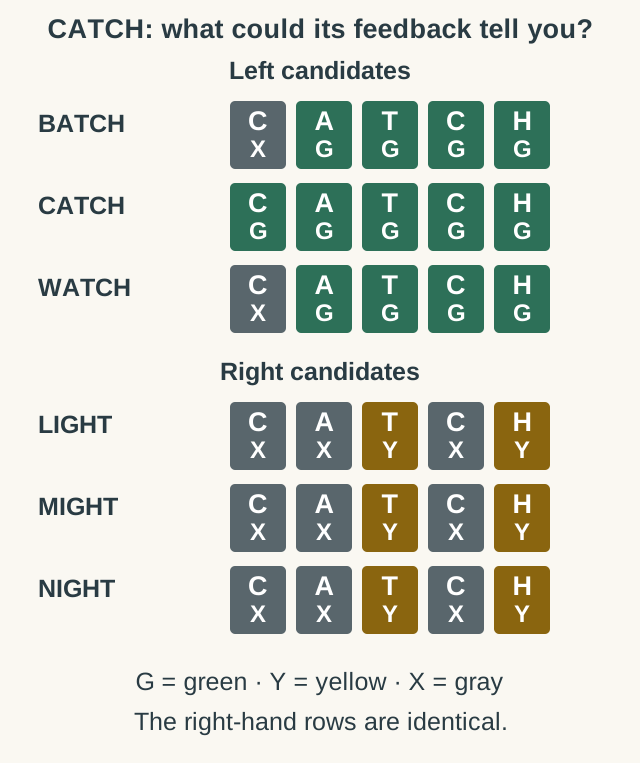
Even if CATCH solves the left, you now have two guesses to enter one of three right-hand answers. Guessing LIGHT next does not distinguish MIGHT from NIGHT when LIGHT is wrong. That route can still win, but it has no guaranteed finish within the allowance for this drill.
Test the differences on both sides
CLIMB tests C and B on the left, and L and M on the right. In these particular shortlists, each possible answer gives it a different feedback row.
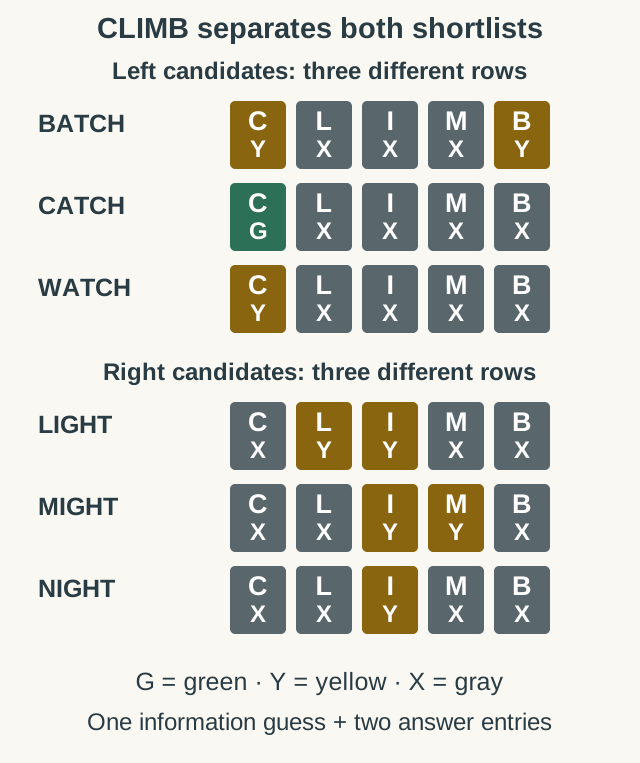
There are nine possible left/right pairs in this exercise. After CLIMB, the two feedback rows identify which pair you have. CLIMB itself solves neither board, but the two remaining guesses are enough to type the identified answers, one after the other.
This works because of the different outcomes, not because CLIMB contains five different letters. A word with five fresh letters can still leave several candidates indistinguishable. Before spending a turn on information, name the uncertainty it will resolve.
The guarantee depends on the supplied shortlists being complete and correct. In an ordinary game, an overlooked word can invalidate that plan. Keep checking every candidate against all earlier rows, including repeated-letter limits.
Choose an opener, then respond to its clues
CRANE and SLATE are reasonable words to practice with, but a ranking needs a stated word set and a stated measure. Here is a small, reproducible comparison using just twelve equally weighted practice answers:
CRANE, SLATE, CLOVE, LEVEL, LEVER, REVEL, LIGHT, MIGHT, NIGHT, BATCH, CATCH, WATCH.
For each opener, group answers that give identical feedback. Then, for each of the twelve possible answers, count how many words remain in its group and average those counts. An all-green result counts as one identified answer, even though that board is already solved.
| Opener | Different feedback rows | Average words left per board | Largest group |
|---|---|---|---|
| CRANE | 9 | 1.50 | 2 |
| SLATE | 7 | 2.17 | 3 |
| ADIEU | 5 | 2.67 | 3 |
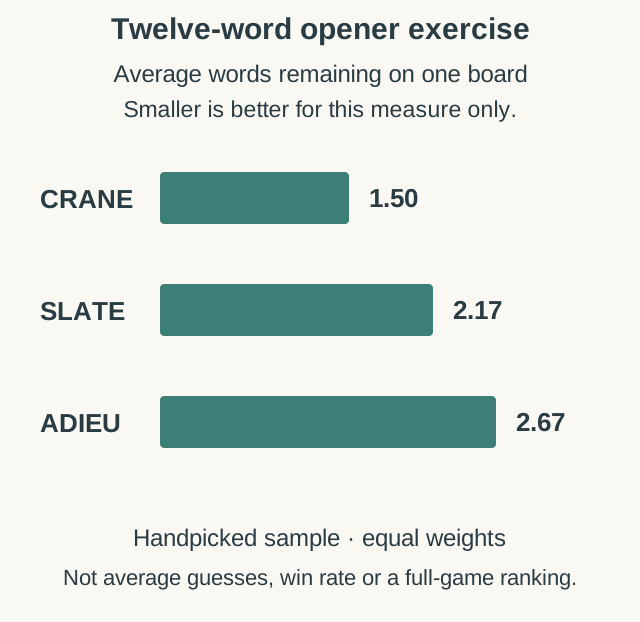
For instance, ADIEU gives the same row for LIGHT, MIGHT and NIGHT: it finds I but tests none of the letters that distinguish those words. CRANE separates NIGHT from LIGHT and MIGHT by testing N.
This sample deliberately includes several similar-word families. It is too small and selective to establish the best opener for the full game, and it does not measure a win rate. Dordle versions can also use different answer lists; the original creator has documented changes to theirs. Do not transfer a numerical ranking between versions without checking what it measured.
Choose a starting word you can interpret, then let the two resulting rows determine your next move. A fixed second opener can waste a turn when the first guess has already narrowed a board to one answer. For a fuller discussion of what opener claims mean, see our Wordle first-guess guide.
Leave room to enter the answers
Identifying a word does not solve its board until you actually enter it. If two boards are still open, plan for two answer entries unless your next guess itself solves one of them. Solving a known answer can also reveal useful clues on the other board, so it is not automatically a wasted information turn.
Try this final check: two guesses remain. The left answer is known to be CLOVE, and the right shortlist is LEVEL, LEVER or REVEL. Can guessing LEVEL guarantee that you finish both boards?
Check the remaining-turn count
No. LEVEL distinguishes all three right-hand candidates. If the right answer is LEVEL, that board is solved and you can enter CLOVE last. If it is LEVER or REVEL, however, both boards still need their answers entered, with only one guess left. Knowing both words is not enough.
Entering CLOVE first does not guarantee a finish either: its right-hand feedback is identical for LEVEL, LEVER and REVEL. You would have one guess left to choose among three. The useful information move needed to happen earlier.
In your next unlimited round, pause before the fourth or fifth guess and compare both shortlists. Look for a word that separates their remaining differences, then count the turns needed after each possible result. When two boards feel manageable, Tridle offers the same shared-guess idea with three boards and eight guesses.
Watch a two-board solve
Scott Stro-solves' Sometimes you need to check for double letters... and sometimes you don't. opens with a Dordle solve. Watch how the same guesses produce different clues on the two boards, and where a repeated letter enters the reasoning. The video uses its own historical puzzle; our practice shortlists above are separate.
Sources and scope
The seven-guess allowance, solved-board behavior and keyboard description follow the visible GridPuzzles rules, checked October 30, 2026. Dordle was created by zaratustra; the creator's word-list update is a reminder that versions and lists change. The shortlist drill, feedback tables and twelve-word comparison are original constructed exercises, not a claim about today's answers or an optimal solver.