After SLATE returns five gray tiles, CHIRP is a useful second-word option: it tests five different letters that SLATE hasn't ruled out. If A, T and E instead turn green, the same CHIRP guess has a different job. It can only gather information, because it can't be the answer.
There isn't one second word that fits every first row. Start with the pattern you actually received. Below, three different SLATE results lead to different decisions. The word lists are constructed practice examples, not the current Wordle answer list or recommendations for today's puzzle.
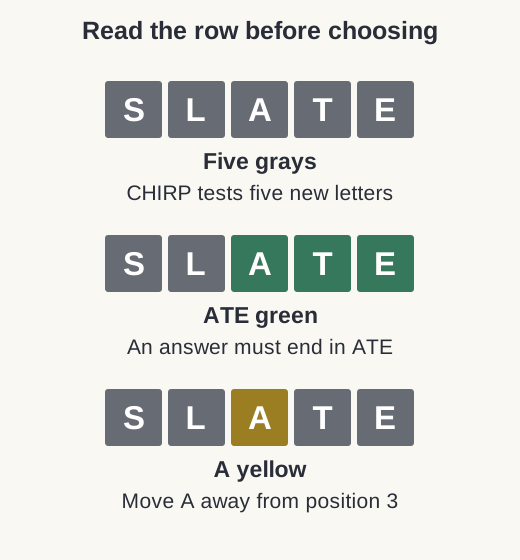
After five grays: spend the next row on letters still in play
An all-gray SLATE rules out S, L, A, T and E. These are five distinct letters, so there is no duplicate-letter ambiguity in this row. O and U are still available, as are I and many consonants.
CHIRP tests C, H, I, R and P. ROUND is another reasonable word to consider, checking R, O, U, N and D. CLOUD tests C, O, U and D, but its L is already known to be absent. That doesn't make CLOUD an illegal normal-mode guess. It means only four of its letters can add new information here.
Counting new letters is a starting point, rather than a complete ranking. Their positions matter, and so do the possible answers those letters separate. Consider only the following nineteen words for a small exercise:
CHIRP, CHOIR, CHURN, CRIMP, CURIO, PRION, RHINO, ROUND, MOUND, DRINK, DRUNK, BRICK, PRICK, QUICK, JUMPY, HUMPH, CYNIC, FURRY, WORDY.
Every one gives five grays for SLATE. A CHIRP guess produces seventeen distinct feedback patterns across this list. CLOUD produces twelve. This count says how many different groups the guess creates in this exercise. It doesn't establish a best second word across the real game's dictionary.
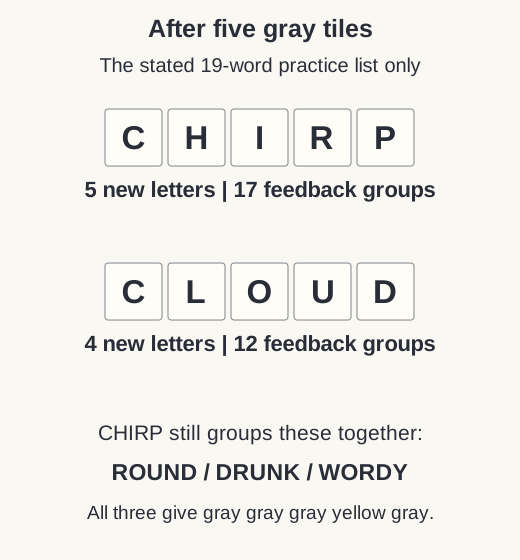
If that yellow R is the result you get, resist treating seventeen groups as seventeen guaranteed solves. Those three words remain indistinguishable in this particular group. Read the next row against the survivors, rather than returning to a fixed list of opening pairs.
With ATE green: decide whether to try an answer or separate them
Now suppose SLATE gives gray S, gray L, then green A, T and E. The answer ends in ATE. A fresh-letter guess such as CHIRP cannot win immediately, even if it is allowed in normal mode.
For this exercise, suppose the remaining answers are exactly ABATE, CRATE, GRATE, IRATE and ORATE. All five fit that first row. Notice ABATE: one green A doesn't tell you there is only one A in the answer.
GRATE is a possible answer and can win now. If its G is gray and RATE is green, though, CRATE, IRATE and ORATE still look identical. You've found more green tiles without choosing between those three words.
In normal mode, GROIN separates all five practice answers:
| Possible answer | Feedback for GROIN |
|---|---|
| ABATE | gray, gray, gray, gray, gray |
| CRATE | gray, green, gray, gray, gray |
| GRATE | green, green, gray, gray, gray |
| IRATE | gray, green, gray, yellow, gray |
| ORATE | gray, green, yellow, gray, gray |
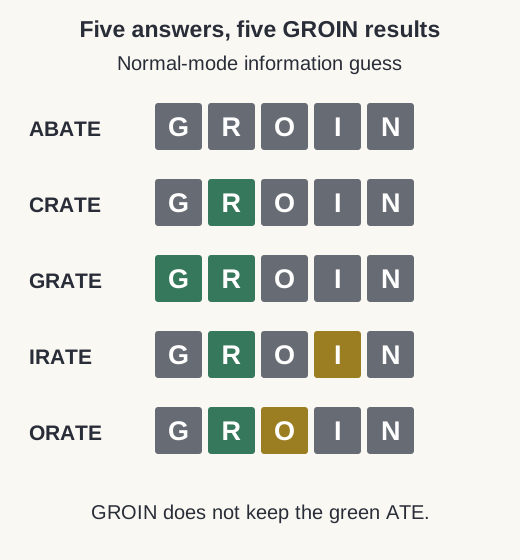
GROIN can't itself win from this list. It spends a turn to identify which answer to enter next. GRATE trades some separation for a chance to finish immediately. This comparison is useful when you can name the alternatives. It is much weaker if your mental shortlist has missed several possible answers.
In hard mode, keep the established greens and reuse revealed yellow letters. GROIN fails the green ATE requirement in this example, so it isn't an available option. Choose a clue-fitting word such as GRATE and work with the feedback it supplies. Don't carry a normal-mode probe into a mode that disallows it.
A yellow A: move it before calling a word an answer
For a different first row, let only A turn yellow in SLATE, with the other four tiles gray. A is present, but not in the third position. MANGO puts it second and tests M, N, G and O alongside it.
CRAMP also contains A, but leaves it in the same third position. It cannot be the hidden answer after this feedback. A word can look attractive because it covers useful consonants and still fail as an answer. In normal mode you may deliberately play a word that cannot win, but make that choice for a specific information gain, rather than overlooking the yellow position.
Try applying that distinction. After the yellow-A row, which of MANGO, CARGO and CRAMP could still be an answer, using only the first row's clues?
See the answer
MANGO and CARGO fit. Both put A second and contain none of S, L, T or E. CRAMP puts A third, where the yellow tile has already ruled it out. This only checks consistency with the clues. It doesn't establish which word the puzzle has chosen.
Practicing the choice across two boards
Dordle applies one guess to two boards. You might get five grays on one and a useful green ending on the other. Check both before playing a memorized second word. A guess that cannot solve the green-ending board can still earn its turn by separating possibilities on the other one.
The same issue appears with three boards in Tridle. Treat each board's clues separately, then choose the shared guess. These are multi-board games, so the single-board Wordle exercises above don't establish an optimal strategy for them.
For the opening move itself, see what SLATE can and cannot do as a first guess. This page starts after those five tiles have changed color.
Watch a guess change after the first row
Grant Sanderson's Solving Wordle using information theory, on 3Blue1Brown, demonstrates how feedback changes a solver's next choice. Its historical word lists and model are context for the explanation, not a current ranking of second words.
Sources
Alexander D. Healy, On Optimal Strategies for Wordle distinguishes the goal of winning immediately from reducing uncertainty, and describes choosing a new guess for each feedback group.
Dimitris Bertsimas and Alex Paskov, An Exact and Interpretable Solution to Wordle models a position using the guesses and feedback already seen. Its published results apply to the paper's stated word lists and rules.
The practice lists, comparisons and figures on this page are original examples. They use ordinary green-first, then yellow scoring for repeated letters. They aren't reproduced from either paper or a daily puzzle.