
Learn locked candidates and pairs before spending a whole solve hunting X-Wings. They give you a way to remove notes when no digit is ready to place. After an elimination, look for a single again; a harder pattern can do its job without filling a cell itself.
That is a useful learning order, rather than a rule that every puzzle follows. The clues on your board decide which search is worth making. A box with one digit confined to a line calls for a different check from a row containing two identical candidate pairs.
Choose a search from the notes
A candidate is a digit still possible in an empty cell. Keep the notes complete enough for the technique you are using. Two cells marked 5 and 9 form no useful pair if one of them could also be 3 and that note was simply forgotten.
| What you can see | What to check next |
|---|---|
| One note in a cell, or one possible place for a digit in a row, column or box | Naked or hidden single |
| Every possible place for one digit in a box lies on the same row or column | Locked candidates: pointing |
| Every place for a digit in a row or column lies inside one box | Locked candidates: claiming |
| Two cells in one row, column or box have only the same two candidates | Naked pair |
| Two digits appear only in the same two cells of one row, column or box | Hidden pair |
| One digit has two possible positions in each of two rows, in matching columns | X-Wing |
| A two-candidate pivot sees two suitable two-candidate wings | XY-Wing |
For pointing, the digit must occur somewhere on that line inside the box. It therefore cannot occur on the rest of the line outside the box. Claiming reverses that relationship: a line reserves the digit inside one box, so other cells in that box lose it. The restriction comes from all available places for the digit, not merely the two that catch your eye.
Use Sudoku practice to work on one family at a time. If candidate marks are still unfamiliar, return to the Sudoku rules and first moves before treating an incomplete set of notes as a proof.
What a small practice-board check showed
For this article, one valid path of logical deductions was checked on 20 Hard, 20 Expert and 20 Evil practice boards. The figure counts boards where a technique was used at least once, not the number of eliminations it made. Each board had a unique solution, and the deductions preserved it.
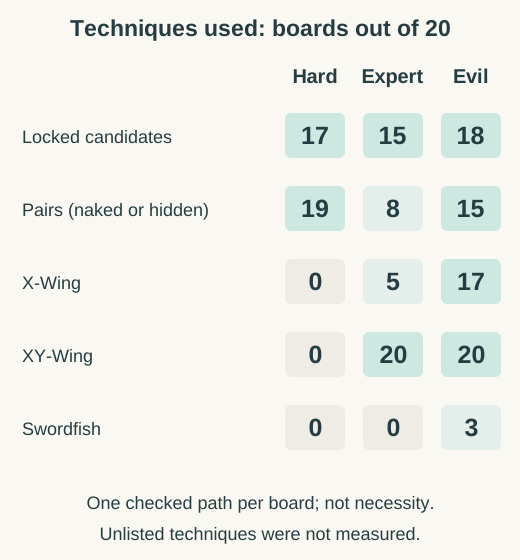
Both kinds of single appeared in all 60 paths. In the Hard group, naked pairs appeared on 16 boards and X-Wing on none. In the Expert group, X-Wing appeared on 5 boards and XY-Wing on all 20. Swordfish appeared on 3 of the 20 Evil boards.
Those counts describe this sample and these paths. They do not show that XY-Wing is necessary on every Expert puzzle, that Hard puzzles elsewhere never contain an X-Wing, or that a person would spot the same move first. Different routes can favor different techniques, and different difficulty labels select different kinds of boards. XYZ-Wing, chains and other methods outside this check were not measured, rather than found to occur zero times.
The practical reason to keep the simpler checks is visible in the worked position below: a pair removes one note, then singles take over.
A pair that opens two placements
The teal cells at row 4, columns 1 and 2 each have only 5 and 9 available. Check their row, columns and box against the large digits. The notes shown in those two cells are complete.
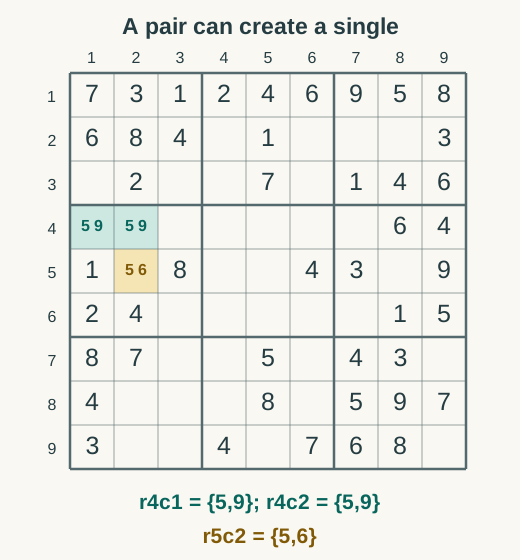
Those two cells share both a row and the middle-left box. One must take 5 and the other 9. You do not yet know which takes which, but neither digit can go in any other empty cell of that box.
Now look at row 5, column 2, immediately below the right-hand member of the pair. Its candidates are 5 and 6. The pair rules out 5, leaving 6. This is a naked single created by a naked pair, not a choice between two guesses.
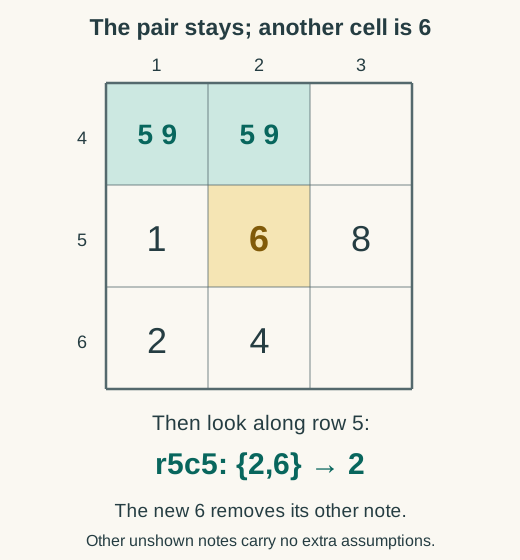
In row 5, column 5, the candidates were 2 and 6. The 6 just placed in that row rules out the second option, so this cell is 2. There is no need to look for a wing between these placements.
Do not pick 5 or 9 for either member of the pair merely because a nearby cell has been solved. The pair reserves two places; it does not choose their order. Likewise, changing one of those sets to {3, 5, 9} would destroy this particular pair argument. Two cells with three possible digits do not reserve just 5 and 9.
Try the next placement
After the 6 in row 5, column 2, consider row 8, column 2. Before that placement it had candidates 1 and 6. Which digit can you now enter, and which shared part of the grid justifies it?
See the deduction and complete solution
Enter 1. The two cells share column 2, so the new 6 removes 6 from the lower cell. Placing the 2 in row 5 does not supply this reason; the column restriction does.
The complete solution to the original position is below. It is included to let you finish and check the practice board, not as a substitute for the pair argument.
| r / c | 1 | 2 | 3 | 4 | 5 | 6 | 7 | 8 | 9 |
|---|---|---|---|---|---|---|---|---|---|
| 1 | 7 | 3 | 1 | 2 | 4 | 6 | 9 | 5 | 8 |
| 2 | 6 | 8 | 4 | 9 | 1 | 5 | 7 | 2 | 3 |
| 3 | 9 | 2 | 5 | 8 | 7 | 3 | 1 | 4 | 6 |
| 4 | 5 | 9 | 7 | 1 | 3 | 8 | 2 | 6 | 4 |
| 5 | 1 | 6 | 8 | 5 | 2 | 4 | 3 | 7 | 9 |
| 6 | 2 | 4 | 3 | 7 | 6 | 9 | 8 | 1 | 5 |
| 7 | 8 | 7 | 9 | 6 | 5 | 1 | 4 | 3 | 2 |
| 8 | 4 | 1 | 6 | 3 | 8 | 2 | 5 | 9 | 7 |
| 9 | 3 | 5 | 2 | 4 | 9 | 7 | 6 | 8 | 1 |
When wings become worth learning
Once you can keep notes accurate and recognize pairs, learn a single-digit pattern such as X-Wing. Its proof follows one digit through two rows and two columns. Do not count only the highlighted corners: check that each selected row really has just those two places for that digit. The column-based version exchanges rows and columns.
The XY-Wing walkthrough asks you to track both possibilities of a two-candidate pivot. Its target must see both wings, which means sharing a row, column or box with each. That is a separate skill from spotting a rectangle. Learn the reason for the elimination before trying to recognize the shape at speed.
Swordfish extends a single-digit search to three rows and three columns. It can wait while you practice the smaller patterns. If none of these searches produces a valid move, check your notes and the exact conditions again; the existence of a hard puzzle is not evidence that a pattern you almost see must be valid.
Watch the box-to-line reasoning
Sudoku Swami's Locked Candidates Type I (Pointing) / Sudoku Tutorial #6 explains the box-to-line restriction used near the start of this learning route. The player starts at the Type I chapter, 5:20. The video uses its own examples; the pair position and practice exercise above are separate original material.
References and scope
HoDoKu's introduction explains the relationship between placements and candidate eliminations. Its naked-subset reference sets out the two-cell, two-digit condition used here. Sudoku Coach's technique overview groups the wider families of patterns. Their examples were not reused for the original practice position or the 60-board check.