A row reading 4, 4, 8, empty becomes 8, 8, empty, empty when you swipe left. It doesn't become 16 immediately. The two Chocolate cupcakes have already made one merge during that swipe, so the two Strawberry cupcakes need another move to combine.
That pause between merges is where many promising trays get awkward. Before taking a move, work out which cupcake it creates, where it lands, and whether its next matching partner can reach it. The examples below use Classic rules in 2048 Cupcakes. Keep Numbers on so you can follow the values without guessing from the frosting.
Follow the result across two swipes
Look at the two Chocolate tiles on the left of the example row. They become an 8. The existing 8 slides beside the new one, but can't join it yet. A later left swipe can make 16 if those two 8s are still together.
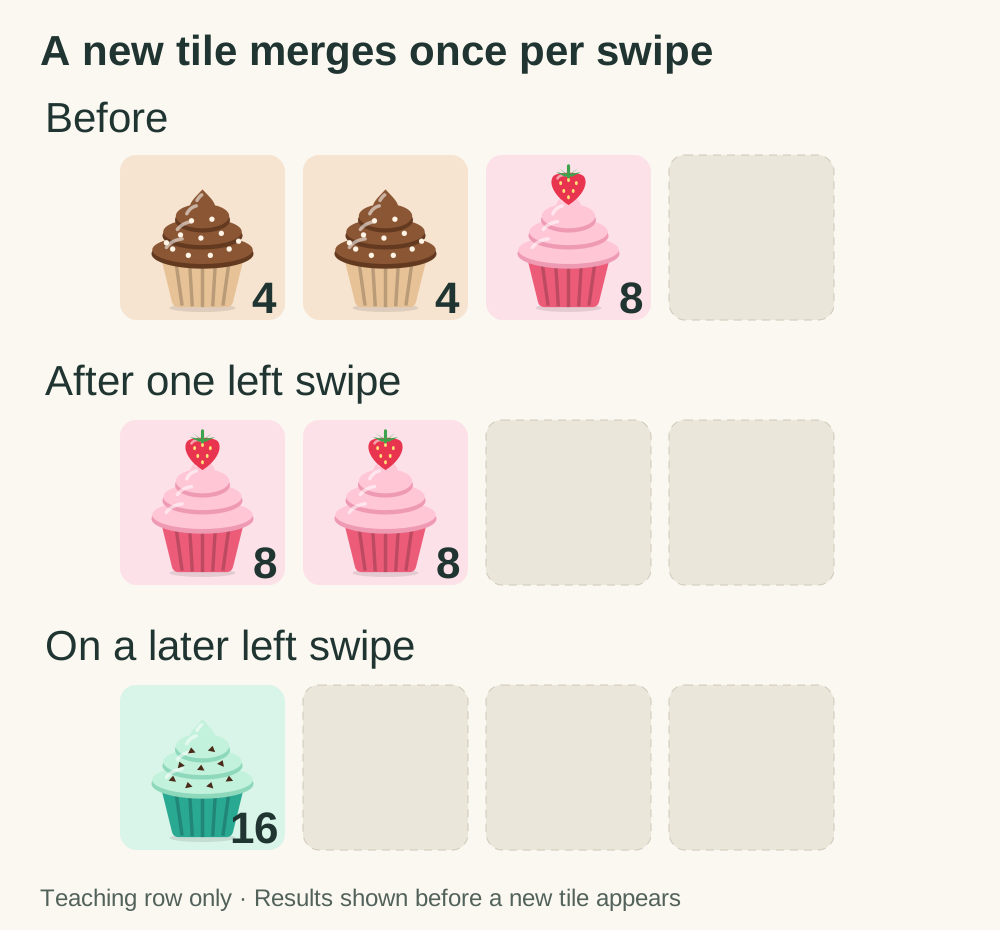
These diagrams isolate one row before the new cupcake appears. In an actual game, a successful swipe also adds a small tile to an empty square. That tile may affect the next move, so inspect the whole tray again rather than pressing left twice automatically.
A row of 4, 4, 4 is different. Left makes 8, 4; right leaves 4, 8 at the other end. One 4 is left over in either case. You haven't lost a merge: three equal tiles contain one pair and a spare.
A small tile can separate a large pair
Two Double chocolate cupcakes don't combine just because they share a row. If a Vanilla sits between them, it blocks their meeting. Swiping along that row moves the group toward an edge but doesn't let one cupcake pass through another.
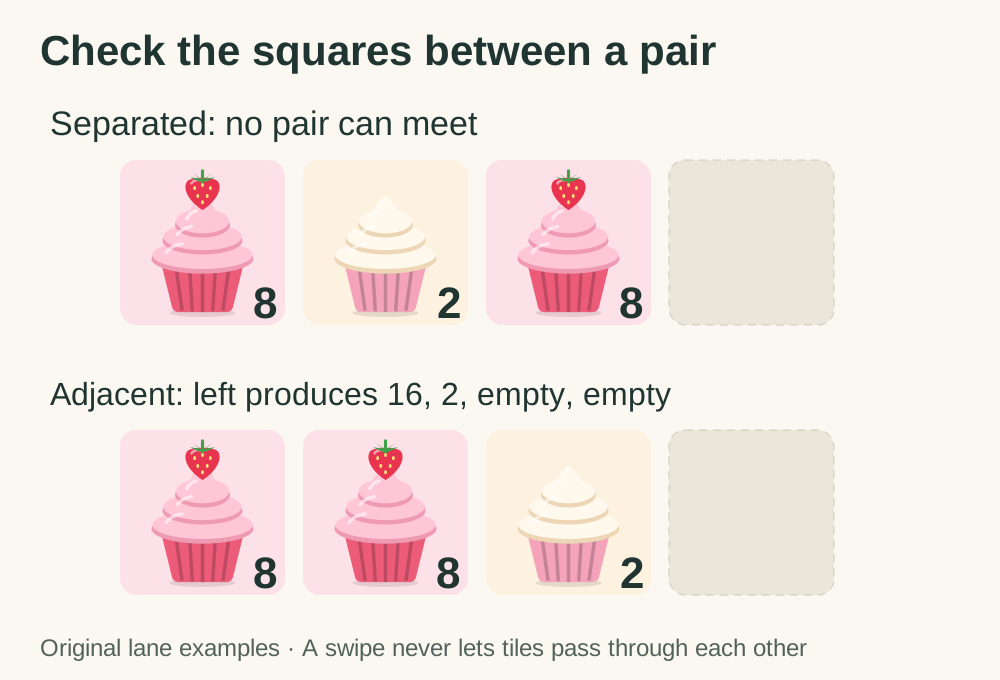
In the simpler numeric example, 8, 2, 8 stays separated on a left swipe. The row 8, 8, 2 can become 16, 2. Before moving a large tile, locate its matching partner and check the squares between them. The same check works vertically.
If the blocker can't be cleared along that lane, inspect a perpendicular move, up or down for this row. You may be able to move the blocker out of the row or combine it elsewhere. That depends on the surrounding cells, not on a fixed left-down routine.
Count the spaces after the arrival
One merge removes one occupied square by combining two cupcakes into one. The new tile that appears after a successful move uses a square again. With one merge, the number of empty squares can therefore stay the same. Two independent merges in a swipe create one extra empty square after the arrival.
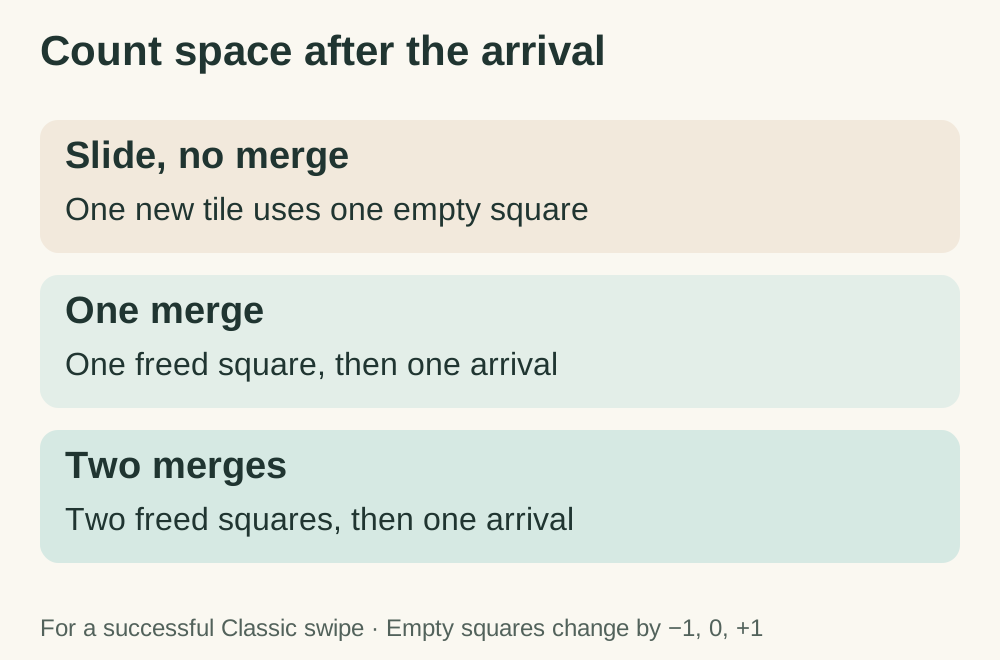
This explains why a small double merge can help a crowded tray. It still isn't automatically the best move: the resulting cupcakes might land far apart or move a large tile into an awkward lane. Compare the usable space and the position you will have, rather than points alone.
A full tray isn't necessarily finished. Adjacent matching values still give you a move. If the tray is full and every neighbouring pair differs, there is no space to slide into and no pair to merge. Diagonal matches don't help.
Use the corner as a plan, not a command
An edge gives a large cupcake somewhere predictable to stay while you build its partner. The separate corner guide compares that positioning in detail. Here, the useful habit is to trace the next pair: which tile are you trying to build beside the large one, and what blocks its route?
If left would leave that route open and right would put a small cupcake between the pair, you have a concrete reason to prefer left. If the board forces another direction, revise the plan. There is no swipe sequence in this guide that guarantees every random tray will win.
Practice: what does 8, 8, 16, empty become on a left swipe?
16, 16, empty, empty, before the new tile appears. The new 16 can't merge again during the same swipe. Inspect the arrival before planning the next one.
Related video
Beat 2048: Strategy Walkthrough (4096) by GamerVsGenius. Watch the movement and matching pairs in this numbered 2048 walkthrough. The Classic cupcake values follow the same rule.