A right swipe can pull your largest tile out of its corner even when the move earns points. The gap in the row matters more than the score animation. Before moving sideways, follow that large tile to the square where it would stop.
The examples below use ordinary 4×4 rules. On 2048 Cupcakes, choose Classic, 4×4 and Numbers to practise with the same values. The diagrams are original practice positions, not a daily puzzle.
The gap that moves 128
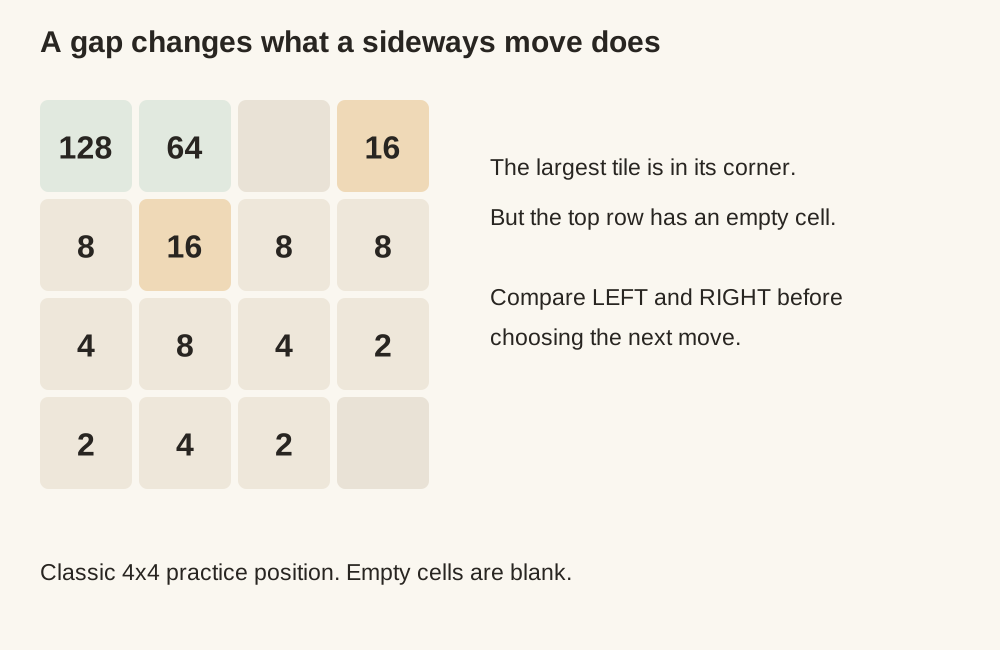
Look along the top row: 128, 64, an empty cell, then 16.
Swipe left and the 16 closes the gap. The 128 stays against the left edge because nothing can move past it.
Swipe right and the row becomes empty, 128, 64, 16. The 128 moves one square to the right. Being the largest tile gives it no special resistance to a swipe.
A full edge row can help hold the corner, but only while that row has no equal tiles that merge. For example, 128, 64, 32, 16 cannot slide horizontally. Change the last two tiles to 16, 16 and a merge creates space. You have to read the row again after it changes.
Both moves score 16
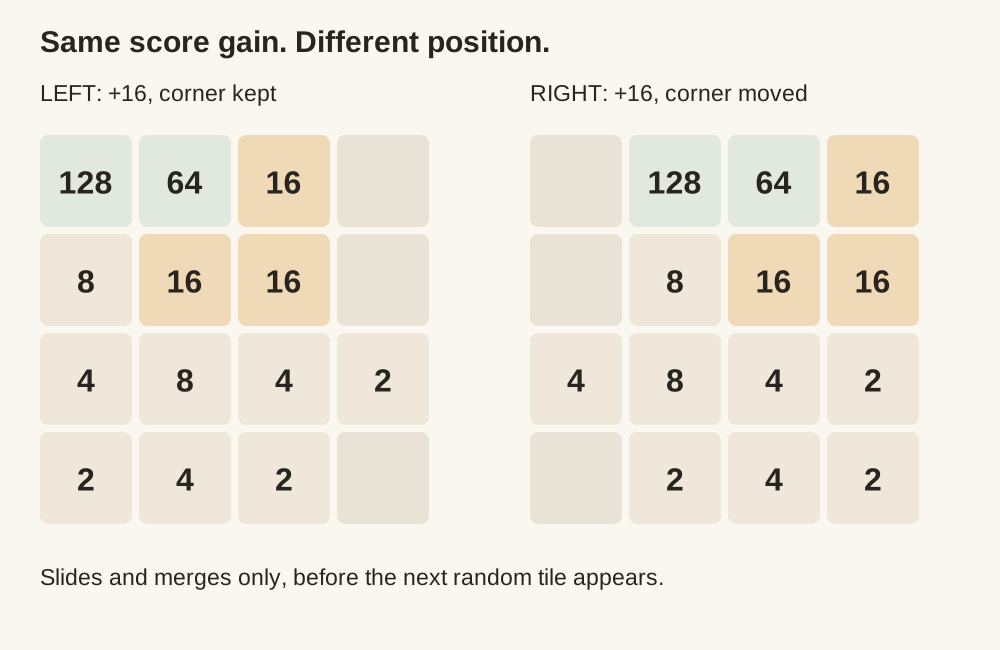
These diagrams show the slide and merges before the new random tile appears.
In the second row, the two 8s on the right combine into a 16 on either swipe. Both moves add 16 to the score. That does not make the resulting positions equivalent.
On the left result, the top row still begins with 128, 64. On the right result, a new tile could appear in the now-empty corner. Moving the largest tile back would then involve dealing with that smaller tile.
The pair of 16s in the second row also illustrates a rule worth checking. One 16 existed before the swipe. The other was just made from 8 + 8. They do not combine into 32 during that same move: a newly merged tile cannot merge again until a later swipe. The original game's rules and implementation use this one-merge-per-tile rule.
For this position, left keeps the chosen corner and gives you an adjacent pair of 16s to work with. It is not a proof that left wins from here. The next tile still changes what you can do.
A corner can survive after the game is lost
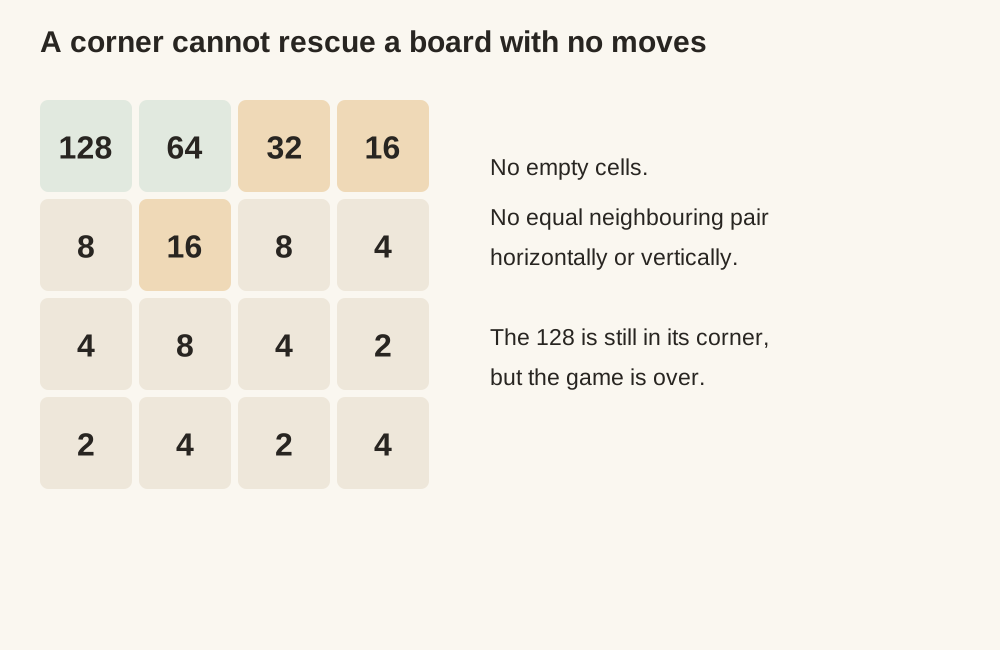
The upper edge is ordered. The board still has no move.
Look for an empty cell in this example. There isn't one. Now check the horizontal and vertical neighbours. No equal pair touches, so no swipe can merge tiles or create space. The 128 is in its corner, but the game is over.
Keeping the largest values together is useful because it makes their next merges easier to plan. It does not replace checking the smaller tiles. Two equal numbers separated by a different value cannot merge just because they share a row.
Research on 2048 position evaluation considers empty cells and the arrangement of neighbouring values alongside ordered rows. That supports treating the corner as one part of the position, rather than a winning rule by itself. It does not establish a win rate for this practice method.
Practise predicting the move
On a fresh Classic board, pause before a swipe that would move away from your chosen corner. Name the large tile's destination, then point to the pair you intend to merge. If you cannot identify that pair, reconsider whether the move helps anything beyond making space temporarily.
Use the Cupcakes board with Numbers visible and compare your prediction with the result. Account for the new 2 or 4 after the slide. The same arrow sequence will not produce the same result on every game.
For rehearsing a move with more room to undo it, Zen mode lets you go further back through your moves. It spawns only 2s, so its results are not a benchmark for Classic play.
Related video
Beat 2048: Strategy Walkthrough (4096) by GamerVsGenius.