
Look for one digit whose remaining positions in three rows all fit inside three columns. Those rows need three copies of the digit, and the copies must use different columns. You can remove that digit from the rest of those columns.
The condition is about every remaining position in the chosen rows, not three convenient cells you can connect. In the original puzzle below, follow the candidate 4 through rows 1, 6 and 7. You don't need to decide which of the marked cells will eventually hold it.
Find the three rows before deleting a note
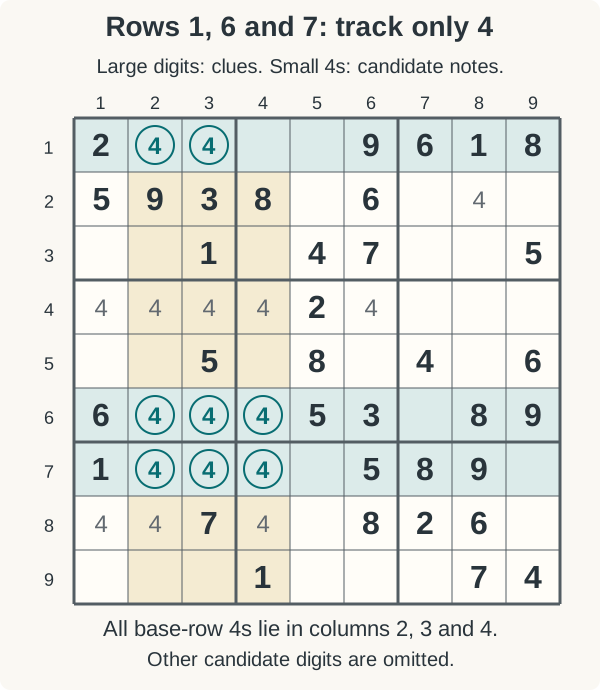
Row 1 has room for 4 in columns 2 or 3. In row 6, it can go in 2, 3 or 4. Row 7 has the same three possible columns. Check the whole length of each row: there is no fourth column available for its 4.
Read those possibilities together. Their combined column list is 2, 3, 4. The rows need one 4 each, and two of those 4s cannot share a column. That uses all three columns, whatever the final arrangement turns out to be.
This is a row-based Swordfish. HoDoKu's basic fish reference describes the same restriction using “base” rows and “cover” columns. Here the rows are the source of the restriction, and the columns are where you look for eliminations.
You do not need nine candidate 4s at the intersections. This example has eight: two in the first selected row and three in each of the others. Andrew Stuart's Swordfish tutorial also distinguishes patterns with different numbers of candidates. Keep the complete set of positions in each selected row, rather than trying to fill out a square shape.
Remove the 4s outside those rows
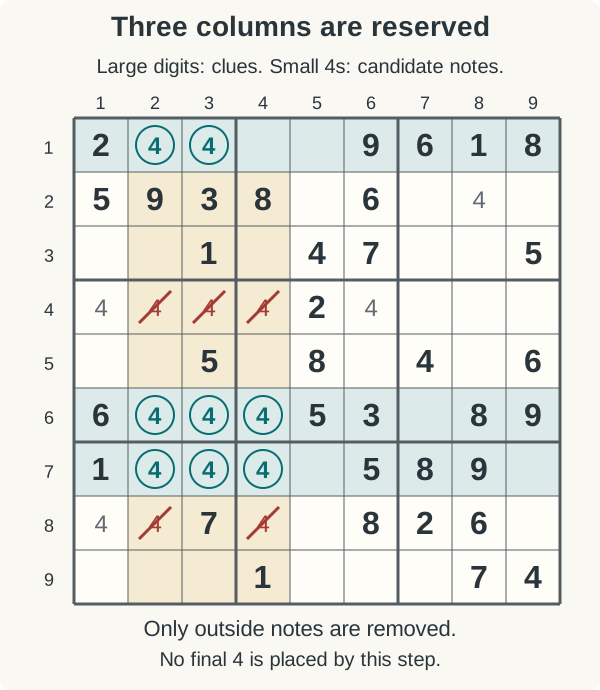
Column 2 can lose 4 from row 4, column 2, and from the cell in row 8. In column 3, remove it at row 4. Column 4 has two more removals, again in rows 4 and 8. Those are the five crossed-out notes in the diagram.
To test the reasoning, imagine putting 4 in the crossed-out cell at row 4, column 2. Column 2 would then be unavailable to all three selected rows. Their three 4s would have to fit in just columns 3 and 4. Two would share a column, which Sudoku forbids. The same shortage occurs if an outside 4 takes either of the other reserved columns.
Nothing in that argument tells you to fill a particular Swordfish cell. For example, the row-column restrictions allow the selected rows to use columns 2, 3, 4, respectively, or 3, 4, 2. The full puzzle will determine the actual placements. For now, delete only the five ruled-out notes and look for the next move.
One extra candidate can break the pattern
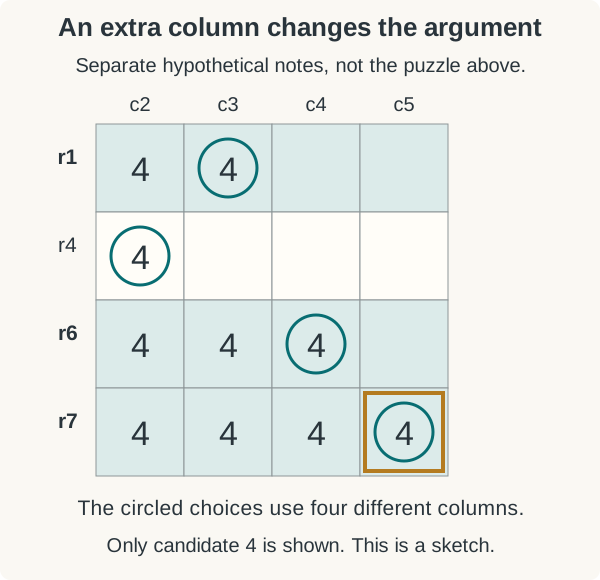
Suppose the last selected row also has a possible 4 in column 5. The combined list now has four columns. It is no longer the three-column restriction used in our proof.
The circles show why: the selected rows can use columns 3, 4 and 5, leaving column 2 for the other row. This sketch does not prove a complete Sudoku solution. It shows that the row-column counting argument alone no longer excludes that outside 4. Another deduction might still remove it.
Do not erase the extra candidate just to make the shape work. Finned Swordfish uses additional conditions and a different elimination test. An almost-matching basic pattern is not permission to delete the same notes.
Check the direction, then practise
If the restriction begins in three columns, reverse the directions: collect all positions of one digit in those columns, check that they lie in three rows, and remove the digit from other columns along those rows. Mixing those directions is a common way to remove a note that belongs to the pattern itself.
For a short check, take these candidate positions for 9: row 2 has columns 1 and 5; row 5 has 5 and 8; row 8 has 1 and 8. What can an unselected row lose?
Check the practice answer
It can lose candidate 9 from columns 1, 5 and 8, wherever it has such a note. The three selected rows collectively use those three columns, with one 9 per row and no repeated column. Keep all six notes in the selected rows. This is a candidate-pattern exercise, not a complete puzzle.
Sudoku Swami's video works through Swordfish examples and then extends the lesson to finned and sashimi forms. The basic row-column restriction is the part used in this article.
Watch Sudoku Tutorial #13-A / Swordfish Examples & Tips by Sudoku Swami on YouTube.
If the two-row version is still unfamiliar, work through X-Wing on one board before searching a larger pattern. The Sudoku rules and techniques guide covers the checks underneath both. You can then look for a useful elimination on an Evil Sudoku board, without assuming every board needs a Swordfish.
On your own puzzle, check for a simpler placement before making a long scan. When you do scan for a Swordfish, follow one digit at a time and include every legal note in each selected row. An old missing note can make three columns look reserved when they are not.