The Skyscraper below removes 4 from r4c1, the square in row 4, column 1. You don't have to decide which of the two “roofs” holds 4. The useful fact is that they can't both miss it.
This is a technique for ordinary 9×9 Sudoku. The separate puzzle called Skyscrapers, with clues outside the grid, uses different rules.
Find the two places for 4 in each row
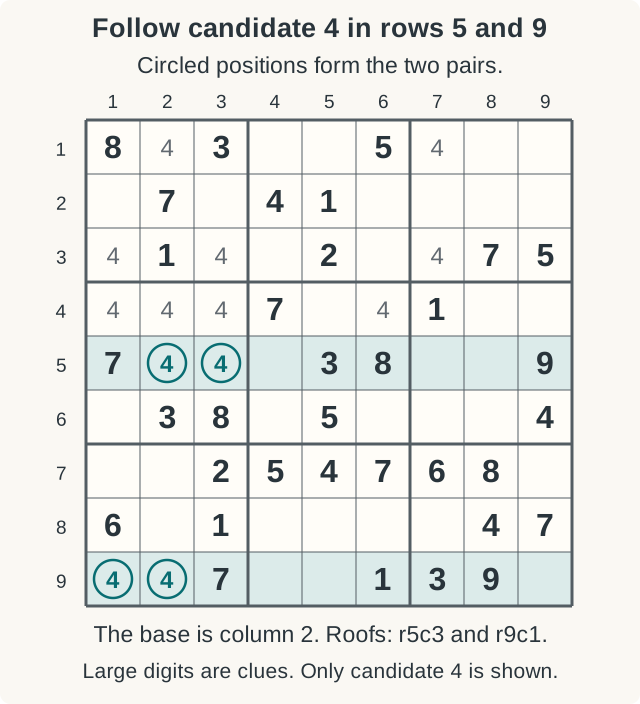
Look along row 5. Its 4 can go in column 2 or 3. In row 9, the choices are columns 1 and 2. The two positions in column 2 form the base. The unaligned ends, r5c3 and r9c1, are the roofs.
| Row | All possible positions for 4 | Base | Roof |
|---|---|---|---|
| 5 | r5c2, r5c3 | r5c2 | r5c3 |
| 9 | r9c1, r9c2 | r9c2 | r9c1 |
Count positions for the same digit across the whole row. Neither selected row has a third place for 4. The marked cells can still have several other notes: r5c2, for example, has candidates 2, 4, 5 and 6. A Skyscraper doesn't require each cell to have only two candidates.
Follow what happens if a roof isn't 4
Suppose r5c3 isn't 4. Row 5 then needs its 4 in the base, r5c2. That rules out 4 from the other base in the same column. Row 9 has only its roof left, so r9c1 must be 4.
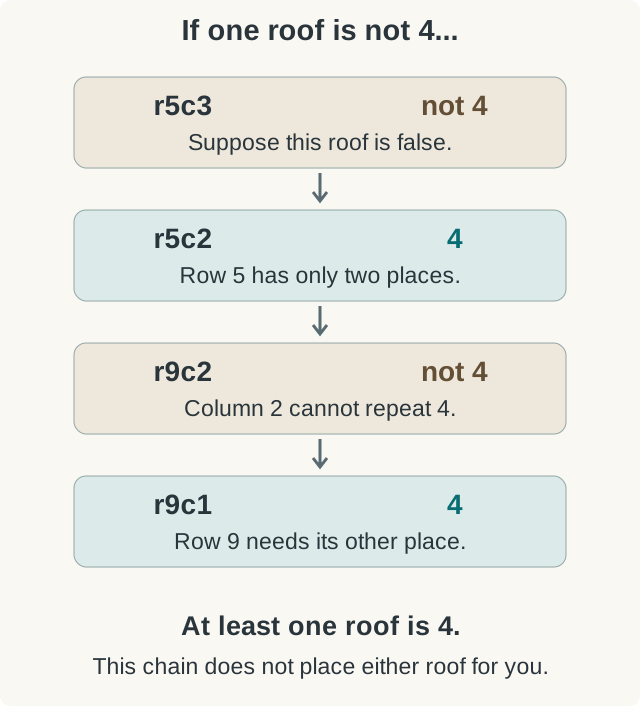
If the first roof does hold 4, you already have a roof containing 4. If it doesn't, the chain reaches a 4 in the other roof. That proves at least one roof is 4. It doesn't prove exactly one: the roofs here share no row, column or box, so the pattern itself doesn't forbid both being 4.
Now check the square at r4c1. It sees the first roof through the middle-left 3×3 box and the second through column 1. A 4 in either roof rules out its 4. Cross that note out.
Its candidates change from 2, 4, 5, 9 to 2, 5, 9. Leave the cell unfilled. This deduction removes a possibility without yet choosing the final digit.
A square that sees only one roof keeps its note
The candidate 4 at r3c1 shares column 1 with the lower roof. It shares no house with the other roof. If the other roof holds 4, the Skyscraper gives you no reason to erase this note.
That distinction matters on this board: the completed puzzle actually has 4 at r3c1. Removing every 4 in a roof's column would erase a correct answer.
Try the check on r4c3 before reading the answer. Can this Skyscraper remove its 4?
Show the practice answer
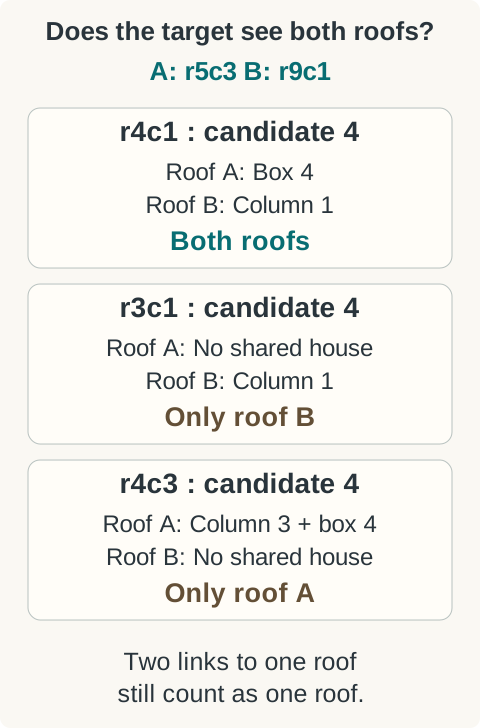
No. It sees r5c3 through their shared column and box, but it doesn't see r9c1. Two connections to one roof still leave the other roof unchecked. Its full candidates are 4, 5, 6 and 9, and this pattern leaves them unchanged. Of the three targets in Figure 3, only r4c1 loses 4.
How to search without forcing the shape
When you're keeping notes in a 9×9 Sudoku, choose one digit and find rows where it has only two positions. Compare pairs that share a column. Inspect the two remaining ends, then look for a candidate that sees both. The same argument works with columns as the pairs and a shared row as the base.
A third possible 4 in either selected row breaks the argument used in Figure 2. If a roof were false, that row could use the extra position instead of its base. Check your complete notes before treating a promising outline as a deduction. The Sudoku rules and note-taking guide is useful if those exclusions are still uncertain.
If both ends line up in two columns, compare the position with X-Wing. Here the roof columns differ, so you need the shared visibility check. A valid pattern with no other candidate seeing both roofs gives you nothing to erase.
Watch the row and column links
Watch dxSudoku's Skyscraper lesson on YouTube. It uses a different puzzle. Follow the two strong row or column links, then check which cells see both remaining ends.
References
HoDoKu's single-digit patterns reference sets out the two-pair condition and its eliminations. Sudoku Coach's Skyscraper lesson explains the roof-and-base view. The puzzle and diagrams above are original examples.