If two unfilled regions can put their crowns only in the same two rows, those rows are spoken for. You can cross out cells in either row that belong to other regions, even while the two crown positions remain undecided.
This is useful when the small regions still offer several choices and placing a crown feels like guessing. The job is to remove a choice you can disprove. A cross can be progress without immediately producing a crown.
The rule set here is the one used by LinkedIn's Queens: one crown in every row, column and colored region, with no two crowns touching, including at a corner. It is different from the chess-style N-Queens puzzle, where entire diagonals are forbidden.
Two regions can reserve two rows
Look at A and B in this original practice board. Both regions occupy cells in rows 1 and 2. Neither extends below them. A needs one crown, and B needs another. Because a row cannot contain two crowns, the pair must use one row each.
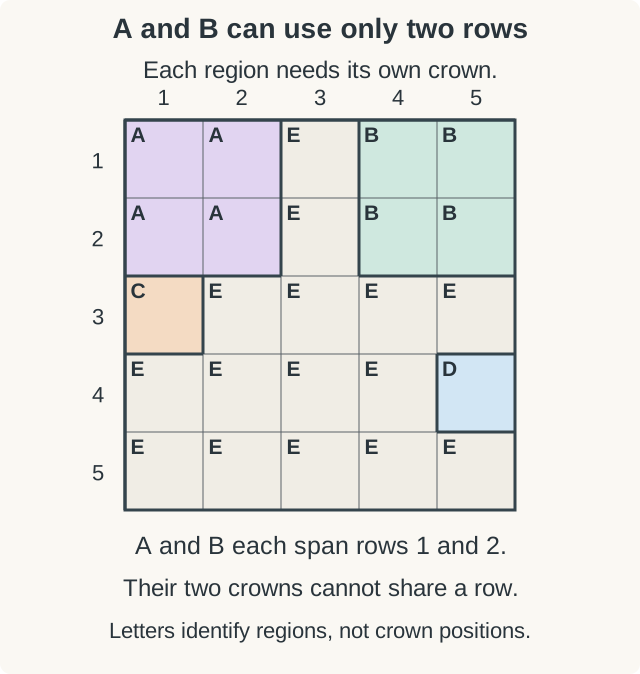
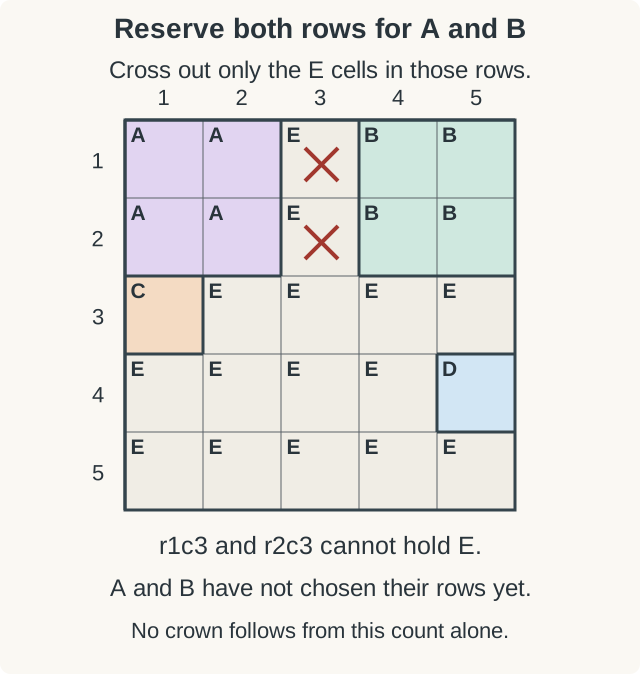
The two E cells between those blocks, row 1, column 3 and row 2, column 3, cannot hold E's crown. If either did, A and B would have only one of the two rows left for their two crowns. That would break the one-per-row rule.
Cross out those two E cells. This argument does not say whether A takes row 1 or row 2, or which cell in either block gets its crown. Keep all four cells in A and all four in B available until another rule removes them.
A column version works the same way: two regions confined to two columns use both columns, so cells in those columns outside the regions can be crossed out. Count the lines that contain all remaining possible cells, not just the portion of a color that catches your eye.
For example, if A still has an available cell in a third row, the two-row argument is not established. Do not ignore that cell to make the pattern fit. It might be removable for another reason, but that reason has to come first.
Try turning the crosses into crowns
Return to the full board. C contains only row 3, column 1, and D only row 4, column 5. Put their crowns there. Cross out other cells in their rows and columns, together with their touching neighbors.
Which cell is now left for A? Check both the column restriction and the touching rule. Then finish B and E. You can use the two crosses from Figure 2, but explain each new crown separately.
See the deductions and finished board
C's crown rules out both A cells in column 1. It also touches row 2, column 2 diagonally, so that cell is out. Only row 1, column 2 remains in A.
With A's crown placed, B cannot use row 1. D's crown already occupies column 5, ruling out B's cell there in row 2. B therefore takes row 2, column 4.
E's crown must be in row 5, since the other four rows now have crowns. Columns 1, 2, 4 and 5 are occupied, leaving row 5, column 3.
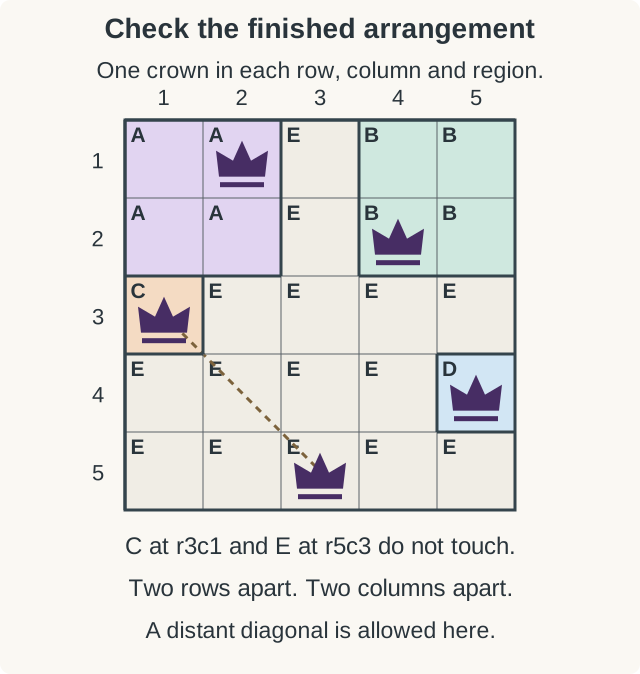
C's crown and E's crown are two rows and two columns apart. They lie on the same diagonal but do not touch. Extending the diagonal ban past the neighboring cells would wrongly remove E's correct crown.
Use the proof, not the shape
When you get stuck, count open choices in each region as well as each row and column. One remaining cell gives a placement. Several regions sharing the same number of available rows or columns give exclusions outside the group. After a new crown, inspect the cells it rules out before searching for another group.
The small board above demonstrates one counting step and its limits. It is not a claim that every Queens puzzle opens with that pattern. A larger board may need other deductions, and a region's full border matters more than whether its outline resembles this example.
Try the argument on a separate Queens practice board. If you need the controls or a simpler single-region example, use the Queens rules and first moves. For a specific LinkedIn puzzle, use the matching date in LinkedIn Queens answers; its region map is separate from this practice layout.
Watch a Queens solving walkthrough
Forgotten Towns' How to solve Queens from LinkedIn very fast with these simple tips & tricks! demonstrates Queens on its own boards. Use the walkthrough to compare how it removes options before committing crowns. Its title is the creator's wording, not a promised solve time for this exercise.
References
LinkedIn's official Queens rules specify one crown per row, column and region, plus no touching. Daily Queens Game's region-elimination lesson explains using a region's available cells to reserve a line. The two-region proof and complete five-by-five example here are separate original material.