
In Queens with colored regions, two crowns can share a diagonal if they are far enough apart not to touch. In the classic N-Queens problem, sharing any diagonal is forbidden. Applying the chess rule to the colored game can make you cross out a perfectly usable square.
There is another difference: the colored game needs one crown in every region. A correct N-Queens arrangement may leave a region empty and put two crowns in another. Neither game's solution is automatically a solution to the other.
The Queens rules discussed here are the ones in LinkedIn's official instructions, also used by Queens on GridPuzzles: one crown in every row, column and colored region, with no crowns touching along an edge or at a corner. Classic N-Queens places N chess queens on an N×N board, with no shared row, column or diagonal. Colored regions play no part in that standard problem.
A distant diagonal can be legal in Queens
Look at the completed arrangement in Figure 1. It has one crown in every row, column and region A–E. Crowns in neighboring rows are separated by at least one intervening column, so none touch.
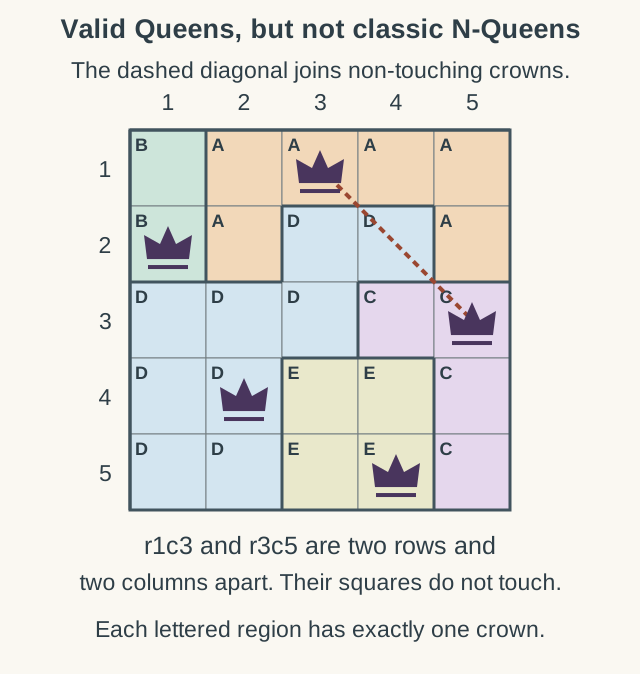
The highlighted pair is r1c3 and r3c5. From one to the other you move two rows down and two columns right. That puts them on the same chess diagonal, but their squares do not meet at an edge or corner. They are allowed by the Queens spacing rule and are in different regions.
For classic N-Queens, that pair alone is enough to reject the arrangement. The chess queen's diagonal reach continues across the board; leaving an empty square between the queens does not remove the conflict.
On a colored Queens board, a crown also rules out its entire row, column and region. Only the diagonal restriction is local. Do not limit row or column exclusions to the eight neighboring squares.
Avoiding every diagonal still may not solve the colored board
Keep exactly the same colored regions, but move the first two crowns as shown below. Their columns, from the top row downward, are now 1, 3, 5, 2, 4.
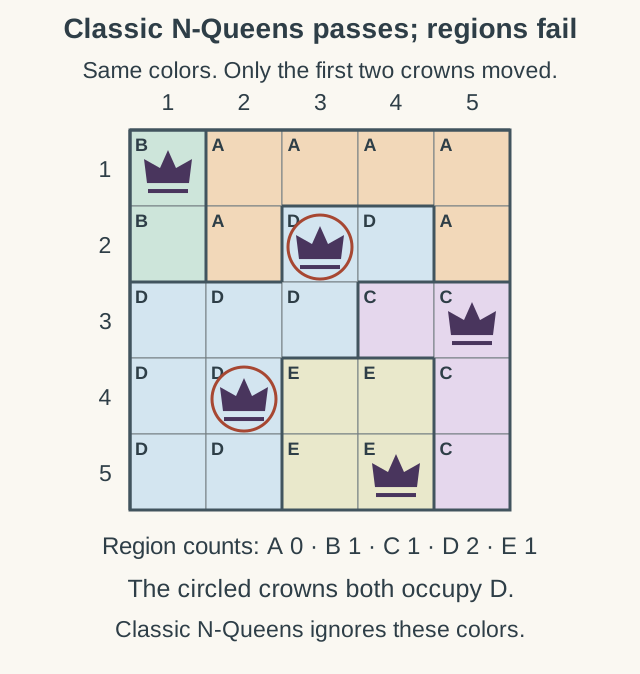
Every row and column is used once, and there are no diagonal conflicts at any distance. The arrangement passes the classic N-Queens rules. Yet r2c3 and r4c2 both belong to D. They do not touch, but that cannot excuse the duplicate region. A also still needs its crown.
This is why “just add colors to N-Queens” is an incomplete description. The region rule is added, while the diagonal rule changes. Keeping the full chess restriction as well would be a different puzzle.
The letters in these two diagrams identify regions; they are not chess pieces or extra clues. Both diagrams use one original region layout. They are teaching examples, not a current daily answer.
Check three possible neighbors
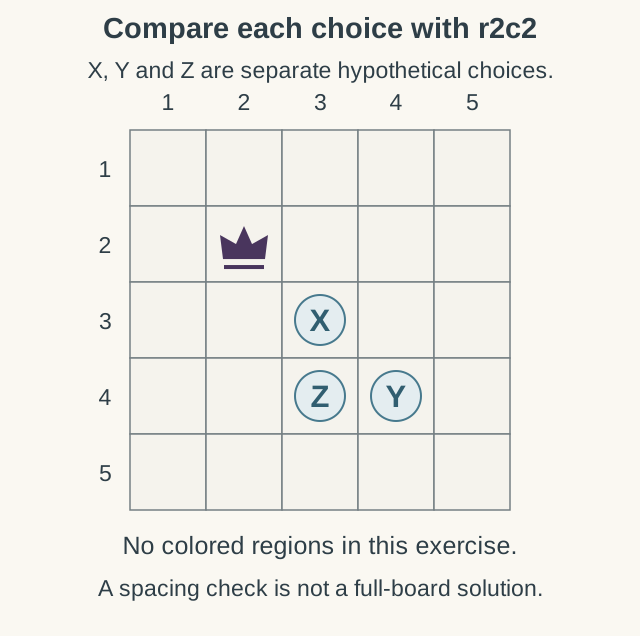
In this separate diagram, a crown sits at r2c2. Test each labeled square against that crown on its own: X at r3c3, Y at r4c4 and Z at r4c3. Which pairs pass the Queens spacing rule, and which pass the classic chess rule?
There are no colored regions in this exercise. A pair passing the spacing test is not a claim that it completes a Queens puzzle.
Show the pairwise checks
X fails both rules. Its square touches the crown's square diagonally. It is also on the same chess diagonal.
Y passes the Queens spacing test but fails classic N-Queens. It is two rows and two columns away, so it is a distant diagonal, like the pair in Figure 1. A full colored puzzle would still require checking Y's region and the other crowns.
Z passes both pairwise tests. It is two rows and one column away. The squares do not touch, and they share neither a row, a column nor a diagonal. Other pieces or region constraints could still forbid it on a complete board.
What the famous 92 solutions count
For the standard empty N-Queens board, counting rotated and reflected arrangements separately gives 2 solutions at N = 4, 10 at N = 5 and 92 at N = 8. These counts come from all completed placements under the full chess-diagonal rule. Google's N-Queens guide gives the same counts.
They do not count solutions to a particular colored Queens board. That board supplies additional region boundaries and uses a different diagonal restriction. Our original five-region example has one solution under the colored rules; Figure 1 shows it. Changing those boundaries would change the problem, even if the board size stayed five.
If you are following an N-Queens explanation that marks whole diagonals, it is explaining the chess problem. For a colored board, use the Queens rules and worked example and follow the region borders. GridPuzzles' Queens link opens the colored-region game, not a classic N-Queens mode.
Watch the colored Queens rules in use
This walkthrough shows the colored-region version. Its early rule explanation and neighbor exclusions are relevant here; its own boards are separate from the diagrams above.
Watch the Queens walkthrough on YouTube. For the classic problem's mathematical specification, see CSPLib's N-Queens definition.