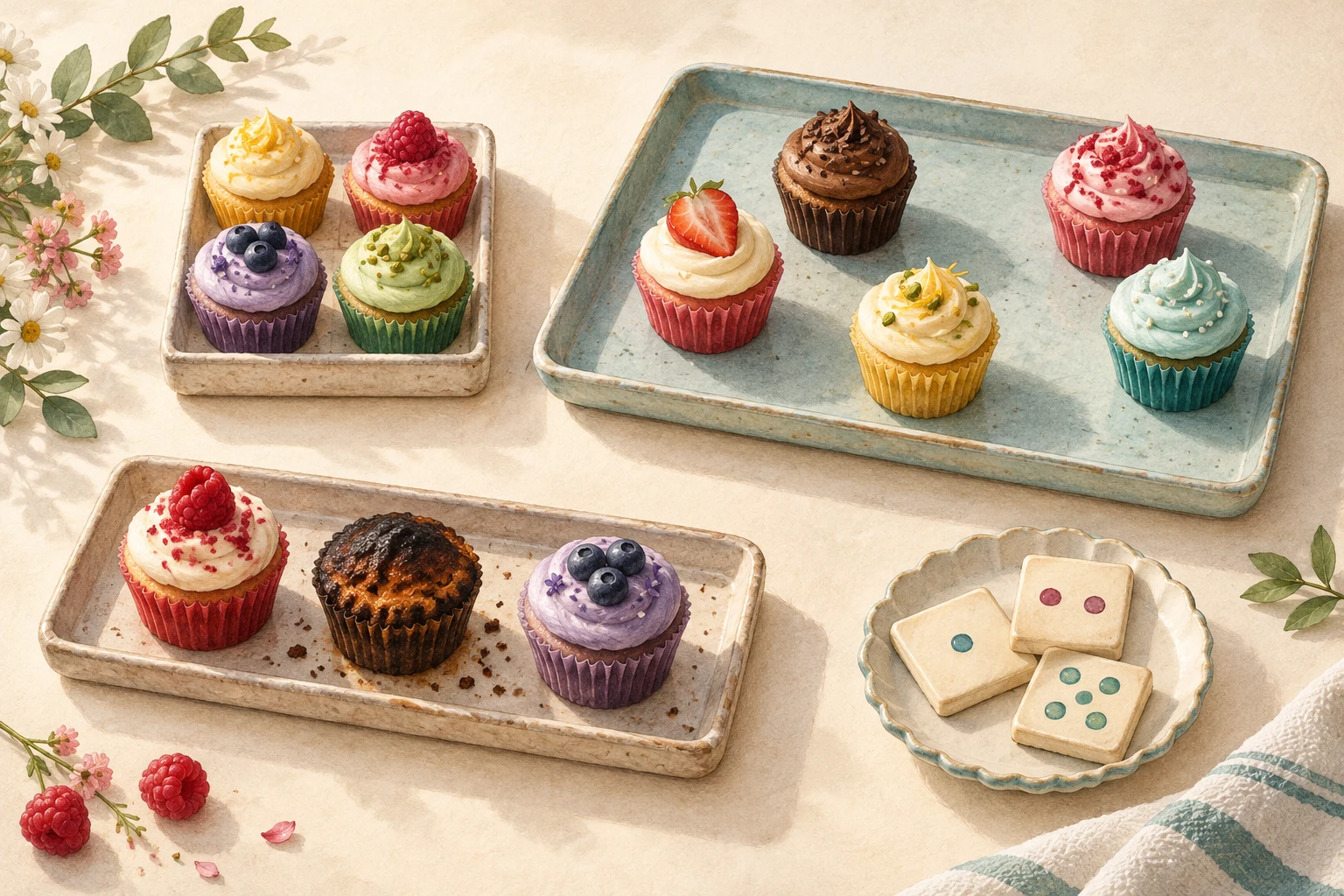
A larger Classic tray gives you more places to manoeuvre. Fibonacci changes which pairs can merge. Burnt leaves obstacles in your lanes. Choose the part of the game you want to change before starting a different mode on the Cupcakes page.
The six modes below are available in the English version. They keep separate games, so you can return to a Classic tray after trying another rule set.
More room on a Classic tray
Try Classic 5×5. You still combine equal values, but have 25 squares instead of the standard 16. A 6×6 tray has 36. For a tighter space problem, Classic also offers 3×3 with only nine squares.
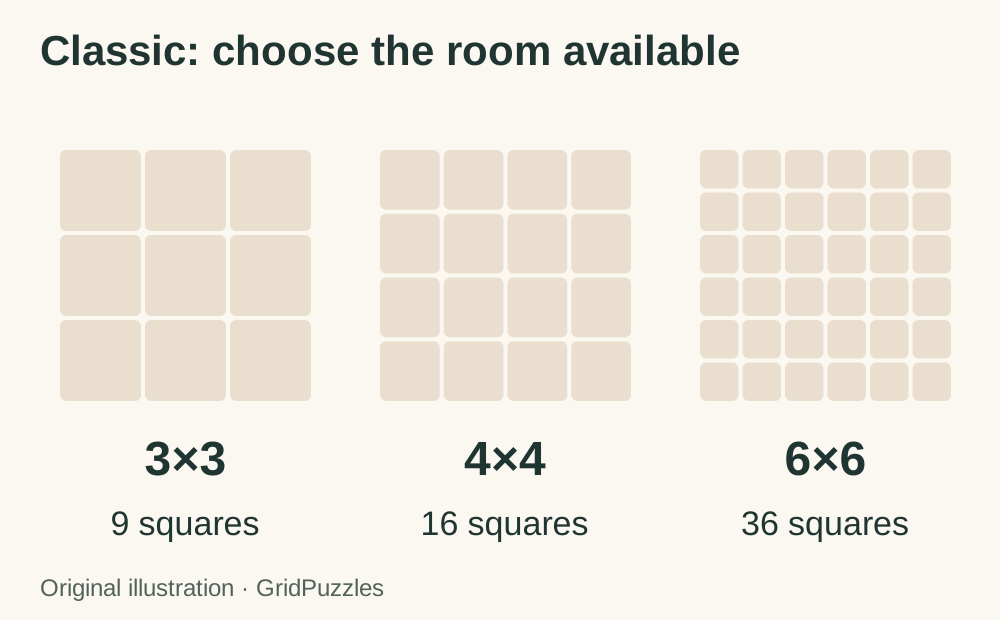
The added room changes how many positions you can use while building a pair. It doesn't change the 2048 crown target. Compare scores within the same tray size: a 6×6 score and a 3×3 score come from different space constraints.
Changing the selector starts or resumes that choice's own game. It doesn't stretch your current 4×4 board into a larger one. Return to the original size to continue its saved tray.
Fibonacci needs a different partner
Choose Fibonacci and watch the values rather than waiting for two identical cupcakes. A 2 can join a 3 to make 5. Two 2s won't combine. The opening exception is 1 with 1, which makes 2.
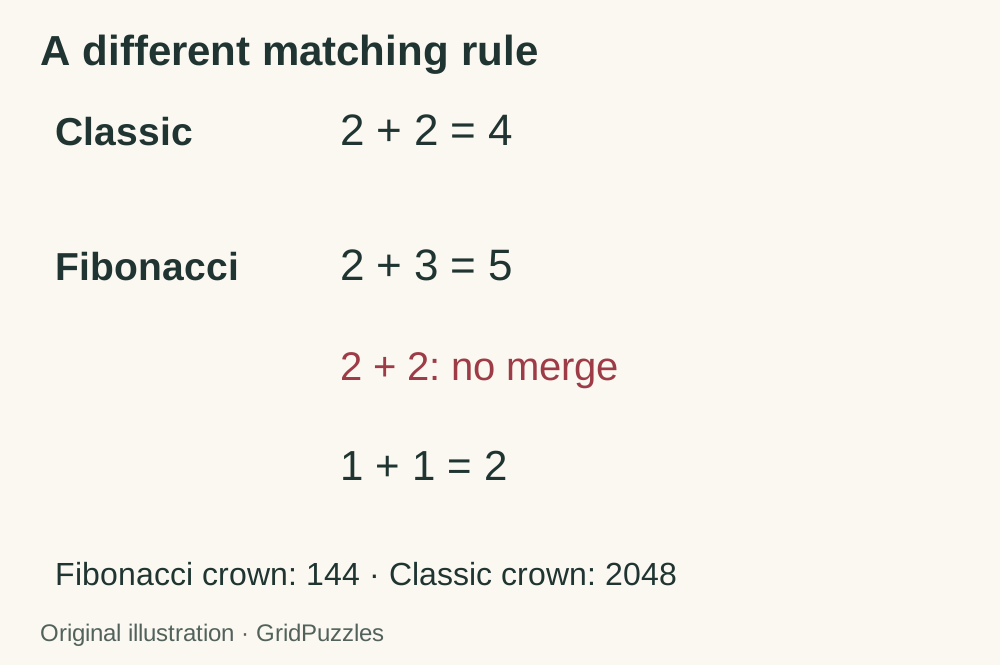
A tray that looks crowded with repeated values can therefore require a different partner rather than another copy. After making a 5, look for a 3 or an 8 beside it. Another 5 won't help that pair merge. The sequence runs 1, 2, 3, 5, 8, 13 and onward, reaching the Golden crown at 144. The available trays are 4×4 and 5×5.
A burnt square divides the lane
Burnt offers 5×5 and 6×6 trays containing squares that other tiles can't enter. A burnt cupcake never slides, even when the rest of its row moves.
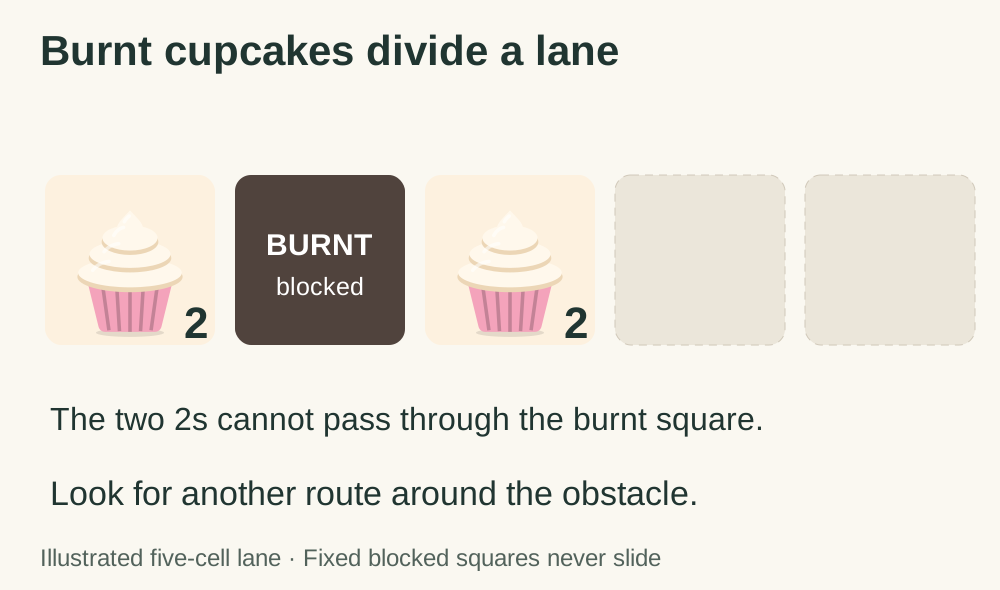
The two 2s in the example can't meet across that square. Look for a route through another row or column. A bigger tray has more squares, but this obstacle can still prevent the direct merge you expected. Check where a lane ends before planning the next pair.
Revisit one decision in Zen
Zen gives you several steps of Undo and only adds the smallest cupcake. Use it to return to a position where one swipe split a useful pair. Try the other choice, then compare where the large tile and the empty squares end up.
You can rewind a stuck Zen tray instead of discarding the whole game. Keep the experiment small: choose one position you understand and change one decision. Returning to Classic afterwards restores the ordinary arrivals and its separate score.
Daily and Rush set a session boundary
Daily starts everyone on the same 4×4 tray. Players who make the same moves also get matching new cupcakes. If you choose different moves, don't expect each new cupcake to land in the same square as another player's. There is one attempt for the day, using the familiar doubling pairs.
Rush supplies a two- or five-minute clock on 4×4. It starts on your first swipe, and Undo isn't available. Choose a duration before beginning. If you want to pause over possible pairs without that limit, stay with Classic.
Leave merging for another puzzle
In Tango, you place suns and moons using neighbour signs and row or column limits. Unlike a Cupcakes swipe, choosing one square doesn't shift every other piece. Try it if deciding a forced placement sounds more appealing than managing random arrivals.
Word Search keeps the scanning but replaces numeric pairs with hidden words. Choose it when finding a pattern is the enjoyable part and combining tile values isn't what you want to practise.
Related video
2048 Fibonacci and 2048 Gameplay by Mathieu . This numbered-game demonstration compares Fibonacci with ordinary 2048. The mode buttons and artwork differ from GridPuzzles.